A chapter a day: Robin Hood and the Caliph’s Gold – Chapter Seven
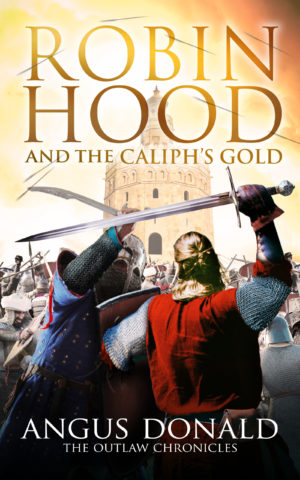
I’ve decided to post a new chapter each day of my novel Robin Hood of the Caliph’s Gold, so that people who are not familiar with the bestselling Outlaw Chronicles series (11 novels have been published so far) can sample it to see if it’s to their taste. In this seventh chapter of my novel, chronologically Book 3 of the Outlaw Chronicles, Robin Hood and his men have been shipwrecked on the island of Crete on their way home from the Third Crusade and have become embroiled in a battle with the local knights . . .
Chapter Seven
The rain clattered down on my steel visor. My whole body was soaked to the bone and I was freezing. My feet felt like lumps of ice. I was having great difficulty in controlling my shivering. I had been lying here beside the dead Cretan horse for more than an hour now, dressed in a Griffon’s helmet and garbed in his fine coat of scale mail, the horse’s blood smeared all over my body but with my own weapons loosely clenched in my hands. It must have been long past midnight by then, perhaps only an hour or two before dawn.
Away to my left, Little John was also lying in the driving rain, his body curled up to disguise his height, a Cretan helmet over his distinctive blond plaits, a big Cretan shield marked with a snarling boar in gold over his tucked up body. We could find no scale armour to fit him but we also knew that, when they finally attacked, if the enemy chose to look closely at the dead bodies of their comrades lying before the barricade, we were doomed.
Beyond Little John, somewhere towards the steep slope of the southern mountainside, Hanno in his own looted scale-armour suit was lying next to his own dead Cretan horse. We were about fifty paces from the barricade, near the front of the swathe of enemy bodies felled by the hoof-holes. I could see through the slit in the visor, the warm, cheery candlelight inside the canvas structure on the far side of the barricade, and the shape of men drinking soup and eating bread and cheese, and wondered for perhaps the tenth time in the past hour, why I had agreed to the icy torture of Hanno’s unusual plan. Could three men-at-arms really make a difference against hundreds? Now, shivering, hungry and wet, it seemed a ridiculous notion. I remembered a maxim of Hanno’s that he repeated during our more gruelling sessions: “More suffering before the battle, is less to suffer during it.”
He meant that if you trained hard, the fighting was much easier. At least I think that is what he meant. Either way, I was certainly suffering now.
The Bavarian had insisted that we removed three corpses, roughly the corresponding sizes of the three of us, and we dragged them behind the barricade and stripped them of their arms and armour. He also said that we could substitute no more than three corpses in this fiendish ruse de guerre.
“If too many living men are pretending to be dead,” he said, “the hazard is bigger they will smell us out. Three is enough to do this task.”
I gripped my sword hilt tightly, trying to control my shaking limbs – corpses don’t shiver – and wished the enemy would get out of their warm blankets, or wherever they were, and hurry up and attack us, if that’s what they had in mind. Anything was better than this waiting. I strained my ears – all I could hear was the rumble of my own folk’s talk behind the barricade.
Owain was behind there now, and perhaps Robin, too: for the loading of the ships was almost complete. Little John had told us that the women and children were already on board the cog, as well as the horses, and our stores; the sailors were making the last preparations on both vessels for a speedy departure. All we had to do was wait till the storm passed and we could go.
All we had to do was hold off hundreds of Cretan angry warriors who knew this rocky terrain far better than us, whose noble comrades we had just casually murdered; all we had to do was hold them off until this raging October storm abated, hold them off till we could disengage from the bloody combat and get all our people safely into the beached ships, then launch those ships, and then we could all merrily sail away, live happily ever after.
Perhaps they weren’t coming. Perhaps they’d seen their knights cruelly slain by our tricks and our massed arrows and decided to wait out the weather in comfort. Perhaps they’d gone home, just decided to cut their losses, and head for their own warm hearths.
My body erupted in a spasm of shivering. I clamped my teeth hard to ride out the bout of violent trembling. I knew that they had not gone home to their beds; they had lost sixteen high-born knights and a handful of slingers and javelin men so far, but they still had the vast bulk of their strength – and they would surely be looking for revenge. The Archon would be looking for more victims to adorn his crosses. The spasm passed. For a moment my body was calm and still. And in that moment I noticed two things. First, the rain falling on my visor seemed to be slackening a little. I took four long, deep breaths, filled with hope – yes, the rain was definitely slowing. And now, it had stopped, only drop or two tapping on the metal over my face.
And the second thing: in the silence, I could make out, quite clearly, the throb of big drums coming from somewhere out in the darkness behind me.
They were coming for their revenge at last.
I could clearly hear the tramp of many feet but dared not turn over and look. I lay as still as I could and listened hard. The deep bass drums were beating the pace, one-two, one-two, slow and steady, and now and then I heard a trumpet sound a stirring ripple of notes. The advance of the Cretans – for it could be nothing else – had not gone unnoticed by my comrades on the barricades. The line there was thickening; I suspected that Robin had drafted in all his men to try and hold the feeble brushwood defence. Sherwood men were mustering from wherever they had been sheltering from the rain or snatching a few hours’ sleep. It occurred to me that I had not slept more than an hour or two for two days, yet I did not feel tired. I was very young, then, not yet seventeen years of age, although I’d seen my share of spilt blood and suffering: I’d been fighting men, from the Humber to the Holy Land, since the first downy hairs sprouted on my parts. More than that, the approach of battle, at the beat of the drum, my young blood stirred, just as it always did.
I felt a little warmer, too, now that the rain had ceased.
I was ready.
The first Cretan stepped right over my prone body; a short fellow in a leather cuirass and a kilt of leather strips reinforced with beads of iron; he carried a spear, a round shield, and had a short sword at his side. He was shod with sandals and his skinny shins were protected with leather greaves.
Not a wealthy man, I thought, as I examined him through the slit in my visor, hardly daring to breathe, not a noble knight – a common foot soldier.
His comrades were all around me now, dozens, scores of them – maybe a hundred or more. They tramped all around, approaching the barricade in an unhurried regular march. There were dismounted knights among them, I could tell, the hems of their shiny scale coats occasionally swishing past my helmeted face. One knightly fellow, with a square-topped helm and a shield with a red sun-burst, paused, standing directly over me. I though for a wild instant that he must know I was an imposter and tensed myself to spring to my feet. But he merely mumbled a loud prayer in Greek, made the holy sign of the cross over my prone, shamming body, and marched onward.
But the knights were few and far between: perhaps three passed over me in sixty heartbeats. For the most part, my head was surrounded by a forest of moving bare brown legs and my great fear was that a Cretan would step on me and I would cry out or move – and so be detected. But I need not have feared – who will willingly step on a corpse? And not a man did so.
The enemy passed quickly around and over me, driven forward by the pulse of the drums. Then a trumpet sounded and a great roar went up and the enemy began to charge at the barricade. I thought I could hear Robin’s clear voice over and above the bellow of the enemy officers, and the pfft-pfft-pfft of arrows. A moment later a goose-feather shaft slammed into the ground beside my face – at least my lord still had a few of them left, I thought.
The legs around my face had gone now, and I told myself I would count to a hundred and then rise and do my duty.
I could hear the fury of the battle at the barricade, the clang and clash of steel on steel, the shrieks and grunts of men striving for mastery; the animal howling of the wilder souls, the pitiful screaming of the wounded; a Cretan officer roaring incomprehensible commands in Greek. I could even hear my lord shouting at the barricade: “Hold fast, lads, we must hold them here . . .”
Then much nearer, another familiar voice, deep and jovial: “Up you get Alan, this is no time for a nap. The younger generation, eh, Hanno, what can you do with them? Lazy as hogs in a wallow, slug-a-beds every one . . .”
I sat up, lifted my visor and looked up at Little John, seemingly bigger than ever, a double-bladed axe over one shoulder, a wide grin on his huge muddy face; Hanno by his side, grim in the darkness, sword and axe in hand.
“Shall we?” said John.
We charged together, the three of us, barrelling straight into the rear of the mass of struggling Cretans who were assaulting the brushwood barricade.
The first the enemy knew of our presence was Little John hacking the head off a man who was loitering at the rear of the scrum, a coward who did not choose to push forward into the press of his comrades and the bloody mash of battle. We sliced into them, the three of us, burrowing deep and deadly into their rear ranks, killing men whose backs were turned towards us – no fairness, no honour to this breathless fight. I stabbed a fellow in the back of his thigh, and chopped into his neck with my shield as he fell back.
Beside me Hanno was killing with an icy controlled fury; dealing out death with both hands, axe and sword, swinging, stabbing, chopping. Little John seemed to be carving himself a kind of tunnel of blood through the enemy ranks, which were still three or four men deep against the brushwood.
I could see Robin and two score of our men-at-arms battling over the barrier, ducking the spear points thrust at them, delivering sword blows overhand, to batter at their enemies’ helmeted heads. No man had broken through yet. And there were still a few archers loosing shafts; Owain, I could see, the master bowman, standing back from the fray, and with a man beside him calling out targets. Other Sherwood folk were thrusting blades, swords and spears through the woven brushwood, skewering men on the other side.
Hanno, John and I were still taking down unsuspecting rear-rank men, chopping into slow-witted fellows with their backs to us; but it could not last much longer. Even now many Cretans were becoming aware of us – scores of them turning, shouting, men whipping round to face us, dozens surging forward; in an instant we three former “corpses” were fighting for our lives.
A Cretan came for me, jabbing with his spear, short controlled lunges, forcing me to block with my shield; at the same time another man hacked at my head from the right. I got my sword up just in time, blocking his blow, and Hanno, two yards away on that side, reached out casually and sunk his axe into the back of the man’s fat neck. I ducked another swinging sword then came swarming in myself, attacking furiously. I batted an importunate spear thrust aside and lunged with my sword, the blade sinking deep into the spearman’s groin, under the lower rim of his swinging leather cuirass.
A Cretan knight engaged me, sword to sword, and the sparks flew as we chopped at each other and clanged our blades like blacksmiths. I ducked under one of his wilder slashes, half severed his left knee and he went tumbling down, yelling out for his mother. The enemy were all shouting their fears now. Not many could see clearly who was attacking them in the darkness, but they knew they were being assaulted from behind.
This was Hanno’s ruse, his grand trick of war. No man likes to think that he may be stabbed in the back while he is bravely fighting the foes to his front. Even a hundred brave men may feel the fear when attacked by only three. The press slackened a little at the barricade, the scrum became looser, men who had once been packed three deep against the brushwood were melting away in front of me, moving to the side, or even running backwards.
Little John was still laying about himself like a whirlwind, his axe a lethal red blur, and no man could approach him and live. A little bald man popped up in front of me and I blocked his swung mace with my shield; he disappeared just as suddenly; and I stabbed another man in the cheek, ripping open his face. Then I was at the barricade, brushwood at the height of my chest; the gore-spattered face of Robin not two foot from my own.
He appeared to be swinging his sword against me, and – utterly astonished – I was just raising my shield purely out of instinct when he shouted, “Down, Alan!” and I ducked, and his blade whistled over my head and chunked into the skull of a Griffon just to my right wielding a dagger.
I heard a roar from behind me and whirled and struck out with my own blade, hacking into the waist of a snarling officer with a pole-axe who was in the very act of slamming it down on my head. He fell away, and I noticed that there was now space on my side of the barricade where there had once been only a packed mass of shoving jostling men. I turned and put my back against the prickly brushwood, lifted my eyes and saw that they were running, all of them, the Cretan infantry were splashing back across the muddy, blood-puddled, corpse-strewn, ground; streaming away, fleeing . . .
I lowered my gore-dipped sword, breathing hard like an old broken-down carthorse, and saw also that the air was lighter over the hills to the east; a paler grey after the black of night, a harbinger of blessed dawn. There was cheering right behind me on the beach-side of the barricade; and Robin was slapping my shoulder and saying, “Beautifully done, Alan, that was exquisitely timed – and executed. I could hardly have done better myself.”
I watched the last of the Cretans trotting away in the distance – still many scores of them, still perhaps half their original numbers or more – retreating back to their camp, and I thought: We did it. We actually did it.
But there was no time for glorious reflection, no time for soaring joy and mutual congratulation. Robin said: “To the ships, everyone; right now!”
And we ran.
Ends
Robin Hood and the Caliph’s Gold is available as a paperback, an eBook and an audio book from Amazon. If you want to start the Outlaw Chronicles series from the beginning, read the first novel Outlaw. This is a list of all the Outlaw Chronicles in the correct order.
Comments (0)