The Mysterious Death of Genghis Khan
As many of you will know, I have been writing a trilogy of historical novels based on the extraordinary true story of a 13th-century Englishman who fought for Genghis Khan (below). As a result, I have been researching the Mongols and their greatest leader for a few years now and one of the things that has leapt out at me in my reading is how little is actually known about the death of the great khan.
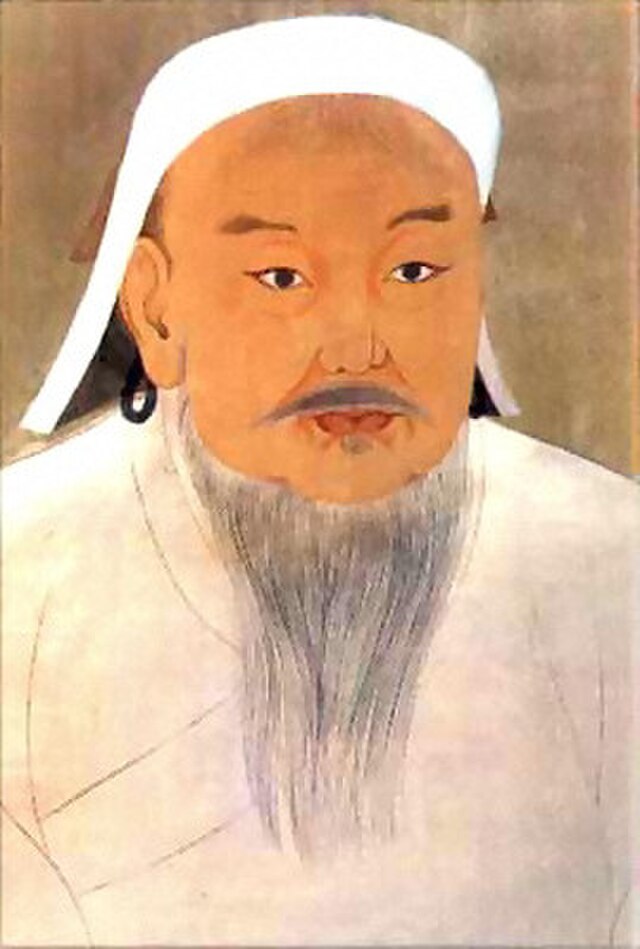
The chief source on Genghis Khan is a book called The Secret History of the Mongols, written by Mongols in their own language after his death in 1227. The Secret History goes into detail about his semi-mythological origins – a blue-grey wolf mating with a fallow deer giving rise to the first Mongol baby – and his complicated steppe feuds and astonishingly successful conquests. It also covers a host of Mongol customs and laws and even tells us about his favourite horse – a red-grey animal, apparently. But when it comes to his demise at the age of about 65, suddenly we get tumbleweed. Nada. Zip. Bupkis.
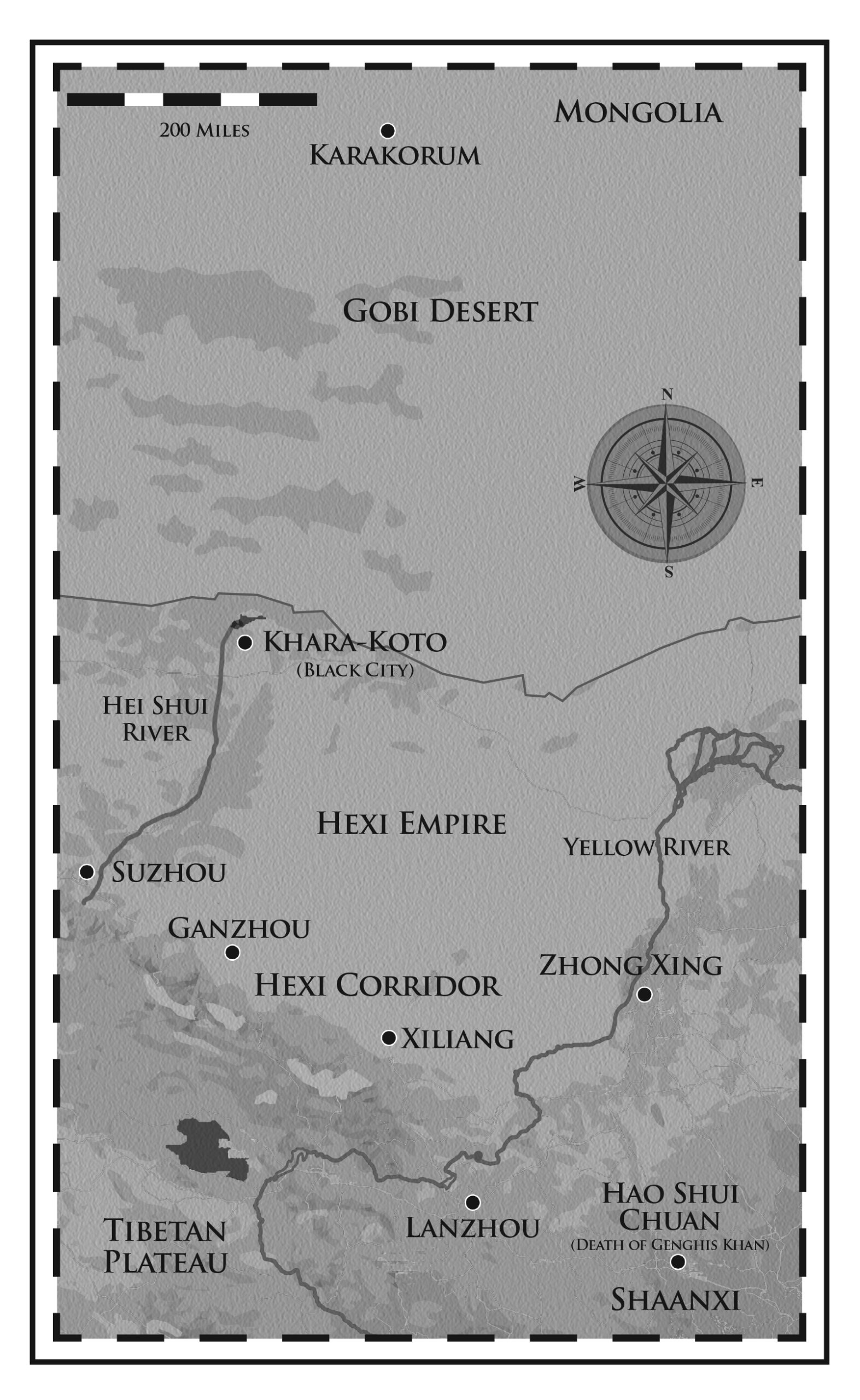
Into this void have flooded a host of tall stories, fanciful tales and outrageous legends over the passing centuries but the more-or-less agreed facts are only these: Genghis Khan died at the end of the summer of 1227 while on campaign against the Hexi Empire (also called the Western Xia) in what is now China. The great khan fell off his horse while hunting, possibly six months earlier, and suffered serious injuries, but he insisted on continuing to campaign against his Hexi enemies. However, the fallout from these injuries later caused him to die.
A boy called Temujin was born around 1162 into a small steppe clan called the Mongols, who were then one of dozens of warring tribes inhabiting the vast grasslands north of the Gobi desert. The Mongols were not a particularly well-known or illustrious clan, though Genghis Khan later claimed they were the descendants of the Huns who ravaged Europe in the 4th century, and Temujin’s own family were, in fact, near destitute. Outcast, outlawed, hunted and, at one point, on the verge of starvation, Temujin somehow survived, escaped from his enemies, then outwitted them, and attracted increasing numbers of followers to his horses-tail banner. Over the next few decades, he defeated all the other steppe tribes and united them under his rule into one great warlike nation.
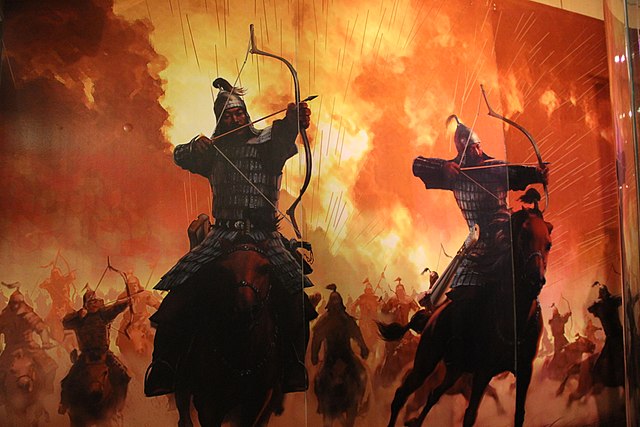
Although they had once been Naimans, Tartars, Kirghiz, Buriyats, Kereits, Merkits and a dozen other peoples, they all shared a similar horse-borne lifestyle, hunting, raiding each other for wives and wealth, and herding their flocks on the wide Asian steppe, and when they had finally submitted to Genghis Khan they all became Mongols. The great khan realised that the only way to keep this unlikely confederation intact was constant warfare, and so began his series of astonishing conquests. Northern China was first (the Jin Empire) and then, after an unforgivable insult to his trade envoys from the Khwarazmian Shah, he turned his horde of horse warriors west and invaded and conquered all of Central Asia and large parts of Persia. His troops hounded the defeated Shah to death in 1220 on the shores of the Caspian Sea.
He had been allied to the Hexi when he went to war against the Khwarazmian Empire and he had asked them for help in the campaign. But the Hexi Emperor refused, saying that if Genghis Khan could not defeat the Shah on his own, he should not go to war at all. Genghis Khan never forgot a slight and so, in the winter of 1226, he left his capital at Karakorum crossed the Gobi (where he sustained his horse-fall injuries) and attacked the Hexi lands. He died just a few days before the fall of the Hexi capital Zhong Xing and the humiliation and execution of the contumelious Hexi Emperor.
Historian Frank McLynn writes in his excellent, comprehensive tome Genghis Khan: His Conquest, His Empire, His Legacy (pp 377/378) “. . . since human nature requires that the demise of a great man can never come about for any normal or banal reason, the wildest rumour began to circulate.”
Some writers claimed that Genghis Khan died in the typhus epidemic that swept the Mongol army that summer. Others said the great khan had died of malaria. Mongol shamans in the Secret History insisted it must have been witchcraft that felled the great man who was so blessed by Heaven. A Franciscan friar called Giovanni da Pian del Carpini, who visited the Mongol court in the 1240s, stated that Genghis Khan had been struck down by lightning. The Hexi claimed that one of their arrows had wounded him in the leg in battle and he had died from septicaemia. The truth is, we simply do not know and, accordingly, I’ve allowed myself a wide latitude in retelling the story of his death in Templar Assassin.

My favourite story about Genghis Khan’s death, and the least plausible, is that he took a captured Hexi beauty to his bed but she, a patriot, had hidden a piece of glass or a steel blade in her vagina and gave him a mortal wound to the genitals.
The Mongol authorities attempted to keep his death a secret and his body said to be was transported in a perfumed sandalwood coffin, banded with gold, back to a holy mountain in Mongolia, where he was buried deep with no marker to show his grave. His successor, Ogedei Khan, declared the holy site of his tomb a forbidden area and thirty maidens were sacrificed, along with the labourers who dug the grave and a large number of his horses to serve the great khan in the afterlife. Another story about his burial, which Frank McLynn thinks more likely, is that the body of Genghis Khan began to compose badly on the long journey home – the Mongols had no knowledge of embalming – and had to be hastily buried en route, probably on the Ordos Plain, in what is now Inner Mongolia. Again, we just don’t know.
And that was the end of perhaps the greatest conqueror the world has ever known. From almost comically humble beginnings he rose to become the most powerful warlord in the world, and he for ever transformed the nations of the globe. At its height, the Mongol Empire he founded covered nine million squares miles, the largest ever contiguous empire. A Mongol horseman could ride from Hungary to Korea and never leave once the great khan’s domain. So, even if we don’t know exactly how Genghis Khan died, or where his body is buried, there is zero chance he will ever be forgotten.
Templar Traitor: the Englishman who fought for Genghis Khan is published by Canelo and is available from Amazon as a paperback, eBook and audio book. Templar Assassin (Book 2 in the Mongol Knight trilogy) is out in August 2026.
Comments (0)