A chapter a day: Robin Hood and the Caliph’s Gold – Chapter Two
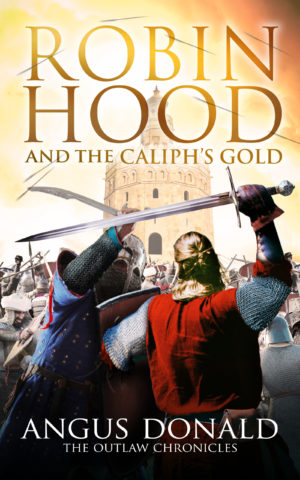
I’ve decided to post a new chapter each day of my novel Robin Hood of the Caliph’s Gold, so that people who are not familiar the bestselling Outlaw Chronicles series (11 novels have been published so far) can sample it to see if it’s to their taste. In this second chapter of my full-length novel, chronologically Book 3 of the Outlaw Chronicles, Robin Hood and his men are on their way home from the Third Crusade, when their ship is destroyed by a terrible storm off the southern coast of Crete and they are cast ashore . . .
Chapter Two
The dazzling Cretan knight on the fine white horse was accompanied by six men-at-arms on foot. The small procession of warriors came plodding up the rough cart track that ran alongside the storm-swollen river between the two spurs of mountain towards our beach. On the northern side of the river was the dense wood of twisted Cretan pines and thick brushwood undergrowth, that side quite impenetrable to man or horse, unless a squad of axe men were prepared to cut a virgin path through the thick vegetation. Between the river and the sheer cliffs of the southern mountainside there was a space no more than fifty yards wide that allowed for a passage, and the marching men, led by the shining mounted knight, came straight down this avenue towards us.
Since the morning when we had lost the round ship, two blazingly hot summer-like days, we’d built a chest-high barricade of brushwood cut from the pine forest, more of a big fence really, and set it across the track between the river and the southern cliffs. That was the extent of our defences.
I was standing guard at the rough gate in the brushwood that served at the entrance to our camp, with two spear-carrying English men-at-arms in sea-swollen leather cuirasses and three of our Sherwood archers – who had the pitiful total of only seven unspoilt arrows between the three of them. The unfortunate disappearance of the Tarrada in the storm had meant we were left with little food or drink, few serviceable weapons and armour – a shortage of arrows, being the most urgent problem, since more than half of our men were archers. Robin had already put us all on half-rations.
In contrast, the approaching Cretan knight and his men were beautifully equipped. The mounted man was clad in a shining coat of tiny steel plates, each plate shield-shaped, thumb-nail sized and sewn on to a leather garment that fell almost to his ankles. The effect was to make him look as if he was covered in glittering scales, like a fish. His right hand held a long lance with a large shining leaf-shaped blade; a long, jewel-hilted sword hung from his belt, and a mace, a great spiked iron club, hung from his ornate saddlebow. He had a shield shaped like a huge teardrop and painted a brilliant white, with a golden device that resembled a bull. His horse, a mighty charger, was draped in a pure white trapper, and the bull device was echoed on its chest and flanks. In the bright Cretan light, he dazzled us like a second sun and his men were only slightly less splendid – each soldier in iron mail coat and white surcoat with the bull-device on his chest and shield, and equipped with an ash-shaft spear, a round shield, a dagger and long, straight arming sword.
I hungered for those fine arms – a part of me wished to take them forcibly from the Cretans. For, despite their glittering splendour, I did not feel that the approaching strangers posed much of a threat to us: I believed myself the match in battle of any knight, no matter how dazzlingly clad. And my archers – even with only a handful of arrows – could take out at least four of the men-at-arms before they got within fifty yards, if I gave the order. Moreover, there were more than a hundred good Locksley fighting men within earshot and, poorly armed or not, I was confident we could dispatch this small band of intruders in the time it takes to scoff down a mutton pie.
I was fortunate, in that I had a good iron mail coat, just a little rust-stained from the sea air, and a well-worn old arming sword buckled around my hips – pure luck, really. I had been wearing both items when the storm had struck the Tarrada, having just completed a vigorous combat-training session with Hanno, who was also similarly accoutred. It had been our daily habit on the long, dull voyage from the Holy Land to practice our swordplay on the forecastle for an hour or two in the afternoons. I also had a back-up weapon stuck in my left boot, a long, thin dagger known as a misericorde, from the Latin for “act of mercy” because it was used to give a quick death to mortally wounded knights. Hanno had been giving me lessons in how to best use that murderous tool, too: how to end a man silently from behind, exactly where to strike to disable him at a blow and leave him at my mercy. I’d thought I was a competent warrior. Hanno regularly showed me how much I still had to learn.
The Cretan knight stopped his horse at the barrier, a dozen yards from me, and holding up his hand he halted the six accompanying footmen too.
He said something in a loud voice: a proclamation of some kind, of which I did not understand a word, though I recognised the language as Greek – the language spoken by some of the inhabitants on Sicily we had encountered on the outward journey to the Holy Land. We had called them Griffons and held them in contempt for their greed and cowardliness. I was prepared to feel the same way about this shining horseman. Then he repeated his message in excellent French: “Who are you, stranger, who presumes to enter my lord’s land uninvited with men garbed for war? Name yourselves!”
I straightened my spine, looked directly into the slit in his helmet visor and said: “I am Alan Dale, of Westbury in the county of Nottinghamshire, liegeman of the Earl of Locksley. My lord serves King Richard of England.”
“You are truly servants of the King of England?” the knight had a note of incredulity in his voice, perhaps even respect – but what was even more surprising was that he spoke in English. “The noble Lionheart who made the long pilgrimage all the way from his northern realm to save the Holy Land?”
I wished then I wasn’t wearing a dirty, salt-stained tunic under my rusty mail; that I’d bothered to comb my cropped blond hair before going on duty.
I said: “We are holy pilgrims and protected by order of Pope Celestine in Rome. All who call themselves true Christians are bound to aid us, if they can, and to respect our right of passage if they cannot. We were thrown upon this desolate shore, unwillingly, not two days hence. Our ship was caught in the recent terrible storm and has sunk. We have lost most of our goods and possessions. Who are you to question us, knight – and whom do you serve?”
“We are indeed true Christians – yet we do not recognise the authority of your Latin Church. We honour, instead, the high and holy Patriarch of Constantinople and all his bishops. Nevertheless, in the Name of Christ, I swear that you will not be harmed or molested while you abide lawfully in our land. I am Kavallarious Nikos Phokas and I am here to invite your captains to come to the House of the Archon, half a day’s ride from here. You are summoned to the presence the ruler of this province, Lord Phokas.”
I knew, of course, that the island of Crete was part of the sprawling Greek empire ruled from Constantinople – the great ancient city on the Bosphorus known since antiquity as Byzantium. But I was unsure of exactly how things stood between these so-called Orthodox Christians and our own true Christian forces of the Great Pilgrimage. In May, King Richard had captured Cyprus, which under a rebel scion of the Imperial noble family had declared itself free of the Byzantine Empire but, instead of returning the island to the rule of Constantinople, after capturing it Richard had sold it to the Knights of the Order of the Temple so that they might use it as a base for future operations in the Holy Land. And the Byzantine lords had sent no battalions of troops to assist us in the fight against the Muslim chief Saladin, who was our common enemy. This seemed to indicate ambivalence, at least, if not hostility, to our holy cause. Yet this dazzling, English-speaking knight, this Kavallarious, as he called himself, seemed perfectly civil, even friendly.
I bade him wait outside the brushwood barrier, watched closely by my archers and men-at-arms, and went to consult with Robin.
“We’d better do as he asks,” my lord said. “This is their land, after all, and we could not resist them if they came at us with their full strength. We need help, Alan. Perhaps this great Lord Phokas can provide us with a ship.”
So, less than an hour later, Robin and myself, suitable armed and dressed for travel, with half a dozen men-at-arms, came out to join the waiting Kavallarios and his men. We left Little John in charge of our beach encampment – which the Cretan knight told me was known as Matala by the locals – and formed up beside the strangers, holding ourselves as proudly as we could in our bedraggled state. To be honest, it felt good to be on Ghost’s back once again – and the grey gelding seemed fully recovered from his watery ordeal and stormy night in the wood. The sun was high in the sky as we rode off along the dusty track between the arms of the mountains, leaving the beach and our friends behind us as we climbed steadily, heading generally north-east, I reckoned by the passage of the sun. It was a hot day, hot as an English summer, but a cool breeze off the mountains made the air comfortable and the journey rather pleasant.
I had no sense of danger from our Cretan escort who trudged along ahead of us in their brilliant white surcoats. Robin was walking his mount beside our six men-at-arms at the rear of the column, discussing something with Gareth, one of the senior members of our company. All was peaceful.
The landscape we rode through was of golden-brown slopes, some covered with scorched strands of long yellowish grasses but there were also plenty of gnarled, tough-looking silvery-green olive trees dotted here and there to give shade, as well as more of the twisted local Cretan pines. The loud, steady buzz of insects that filled the air was strangely soothing. I scanned the ridges and skylines of the little round-topped hills we passed, purely out of habit, looking for danger of any kind, but I could feel my senses being caressed and lulled by the warm sunshine and, in truth, I saw nothing on that two-hour ride more threatening than a few capering goats.
“You have not seen this island before?” asked the Kavallarious, who had manoeuvred his horse to walk it next to mine. His English was excellent with only the very slightest Greek accent. I saw that he had removed his pointed helmet in the heat and slung it from his pommel by the leather strap. He was a handsome young man, perhaps sixteen or seventeen years of age, with a long thin straight nose and curly jet back hair, now glistening with oil or sweat. I was bareheaded myself, but with a steel helm and mail coif in my twin saddlebags, which were slung over Ghost’s haunches.
“I’ve seen Crete before but only from the deck of a ship,” I said. “We made a rendezvous on the north coast off Chandax during the voyage to the Holy Land. But we stayed only one night before continuing our journey.”
He nodded. “It is a very beautiful island,” he said. “But quite often overlooked – travellers such as yourself often pass us by without remaining very long. They see Crete as a . . . a backwater, is that the correct word?”
He sounded rather wistful, even a little ashamed of his homeland.
“How come you to speak such good English?” I said. It was a question I had been longing to ask.
“I had many excellent tutors,” he said. Then stopped.
“But why English?” I persisted. “What need of it is there in Crete?”
“I learnt French, too, and a little German. But I wished to speak all the different tongues of the fighting men of the Great Pilgrimage so that I . . . well . . . I wished to join the holy cause, to fight at the side of the knights of Christendom; to recapture the city of Jerusalem for the sake of Our Saviour.”
“Why did you not do so?” I said. “I’m sure King Richard and his nobles could have found a use for another brave knight such as you.”
He smiled at me shyly. “You are kind, sir,” he said. “I wished to join the pilgrimage but my father forbade me. He said I was too young. It was too dangerous . . . So I stayed in my schoolroom studying obscure languages, and mathematics, and rhetoric. While other, better men battled the heathen.”
We rode on in silence for a while. I had never really thought of English as an obscure language. But then we were very far from home. I decided not to take any offence at his words. Indeed, I was warming to the lad. He was clearly intelligent and seemed eager to please. I found that I rather liked him.
Then he said: “I heard there was a glorious battle about a month ago in the Holy Land, a great fight, at a place on the coast called Arsuf. And there the forces of Christ triumphed over the wicked Saracens, is this correct, sir?”
I told him it was, and with no small measure of pride I recounted my own part in it – and brave actions of Robin’s men, too; and the activities of the other contingents of the Christian army, as well. Indeed, as we rode along, I found myself giving him a full description of that bloody day of slaughter – and when I had finished his eyes were shining with excitement.
“So victory was the result of the Hospitallers’ impetuousness,” he said. “That is strange: I have always admired them for their iron discipline. Indeed, I once considered defying my father and applying to join their ranks. But you say they charged the Saracens without Richard’s permission? And he was forced to support their attack and commit to a full-scale assault?”
“That is one way of looking at things. Richard had planned to wait until Saladin attacked him, but . . . well, the King always says that in war no plan ever survives the first contact with the enemy. The main point is, we won.”
“You know the Lionheart personally? Are you then a great noble?”
“Not I. Merely a captain of men in the Earl of Locksley’s service, and the holder of one small manor in England. But the King has been most kind and generous to me and we have made music together – which I believe creates something of a bond between men, even of vastly different rank.”
He frowned at that and said: “That would not be the case in Crete – my father would not dine, or make music, or spend his leisure time with a man who is not of noble blood. He would be dishonoured by that close contact.”
I decided not to take offence once again. “The King did offer to knight me himself,” I said, “if I joined his retinue. I would have been given honours too. But I chose, instead, to continue to serve my lord, the Earl of Locksley.”
He seemed perplexed by my claim to have refused a knighthood and lands but still impressed, nonetheless, with my royal connection, which was not an unpleasant sensation for me. Then he began to tell me about his own wealthy family, and his illustrious lineage, although I confess I did not pay close attention. He spoke at length about his honour and how he cherished it, and how he desired glory above all else in this life, and I was left with the impression of a boy who desperately wished to distinguish himself in battle.
Even at my tender age – and I had seen roughly the same number of years as him – I could have told him that there was little glory in bloodshed. But I was content to listen to him babbling about honour and sacrifice, and a Christian knight’s duty, nodding politely, as we rode along through parched landscape. He seemed a pleasant, eager, enthusiastic fellow. And he clearly meant well in his charmingly parochial Cretan way. As I say, I liked him.
At last, we began to climb a very steep slope up a part of the road that doubled back on itself as it rose in a series of tight zigzags. At the very summit of the hill, I could see what looked like a collection of tumbled ancient ruins, shattered columns and huge blocks of tumbled stone, and off to the side one large square newly built house, covered in shining white marble and topped with a red tiled roof. There were several outbuildings and many tall shady yew trees and the whole establishment was surrounded by a man-high white stone wall, topped with a row of spearheads set in mortar.
“This is the House of the Archon,” said Nikos, “palace of my father Lord Ioannis Phokas, Governor of Phaestos, Mires and the Messara Plain.”
I had gathered from Nikos’s ramblings on the journey that, since Crete had been liberated from cruel Saracen rule two hundred-odd years ago, it had been governed by twelve aristocratic Greek families, sent down from Byzantium by the Emperor himself – each family controlling a particular region of the island. Lord Ioannis Phokas, Nikos’s father, was the head of one of these twelve noble families and the Governor – or the Archon, as it was called in their tongue – of this richest southern province of Crete.
As we approached the gate in the white marble wall, I was struck by two things – first the astonishing view over the Messara Plain stretched out below us to the north of the House of the Archon: a lush bowl of a valley filled with small fields and neat orchards, of olives and barley, of oranges and lemons and figs, the land as green as a jungle in places, and well watered by a long brown river that snaked through the middle. The sight of the valley from this vantage point was breath-taking: I felt as if I were suspended cloud-like over this bountiful landscape with its ripe fields of plenty, which was quite clearly the source of the local Archon’s wealth.
The second thing I noticed was that some of the spear points set on the top of the wall around the House of the Archon were adorned with the severed heads of men, of varying disgusting degrees of corruption. There were some fresher polls, life-like and recognisable, perhaps, by their friends and families, but there were others that were just black, shapeless masses, with shifting crowds of flies swarming eagerly over them. Still others had lost all their flesh and were no more than yellowish, toothy skulls lolling emptily on the spikes, retaining only a few dried scraps of gristle and hair.
It was a revolting sight, at odds with our pleasant sunny ride through the golden hills, the magnificent view and my amiable, rambling chat with young Nikos. It struck a horrible, jarring note; a note of pain and horror in a near-idyllic landscape. But it was not as shocking, not as deeply disgusting, to me at least, as what I saw on the final part of the road leading up to the Archon’s gate. As we turned a corner, I saw that on the far side of the road, the southern side, three huge wooden crosses had been set up.
And they were occupied.
The forms of three naked wretches were nailed up there in a row in a grotesque imitation of Our Lord’s Passion at Golgotha. And at least one of the poor victims, the fellow in the centre with blood-crusted iron nails pinioning both wrists and feet, was still alive. I saw him flex his knees and shove his emaciated body up the wooden plank at his bare back, extending his crossed, pierced feet, pushing painfully upwards against the iron nail to take a great tearing breath into half-collapsed lungs, before slumping again. I was almost as shocked at the blasphemous nature of the punishment, as by its cruelty.
“Who are these men?” I asked Nikos.
“What? Oh, them,” he said, nonchalantly, as though he had barely even noticed this seeping obscenity right on his doorstep. “They are criminals.”
“What sort of criminals?” I asked. I had thought the laws of England were harsh. I had once been threatened with losing my hand by the sheriff just because I had stolen a pie in a market. This seemed even more extreme.
“They are pirates. Just some Saracen pirates. The waters around Crete are infested with them. My father is a scholar – he is fond of reading the classics, the works of Julius Caesar, you know. Caesar famously ended the scourge of piracy across the Mediterranean by hunting down and crucifying all the pirates he could find. The Archon seeks to emulate great Caesar.”
Ends
Robin Hood and the Caliph’s Gold is available as a paperback, an eBook and an audio book from Amazon. If you want to start the Outlaw Chronicles series from the beginning, read the first novel Outlaw. This is a list of all the Outlaw Chronicles in the correct order.
Comments (0)