A chapter a day: Robin Hood and the Caliph’s Gold – Chapter Three
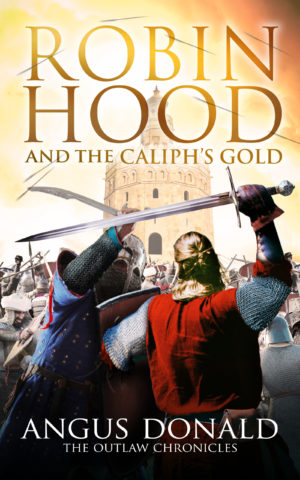
I’ve decided to post a new chapter each day of my novel Robin Hood of the Caliph’s Gold, so that people who are not familiar the bestselling Outlaw Chronicles series (11 novels have been published so far) can sample it to see if it’s to their taste. In this third chapter of my full-length novel, chronologically Book 3 of the Outlaw Chronicles, Robin Hood and his men are on their way home from the Third Crusade, when they are shipwrecked on the southern coast of Crete and must seek help from the local potentate . . .
Chapter Three
Our horses were led away by grooms to be brushed, fed and watered, and the six Locksley men-at-arms were ushered into a mess hall on the far side of a large courtyard, where they were told they would be given refreshment.
When Robin and I had washed the dust from our hands and faces in a splendid golden bowl filled with rose-perfumed water, and had been given watered wine to irrigate our throats, Nikos asked us if we wished to bathe or change our clothes. I looked at Robin: we had brought with us no clothes but the dusty, salt-stained ones we stood in. When we politely refused, Nikos told us to wait until we were called into the Archon’s audience room. After about half an hour, sitting in silence in a long hallway filled with priceless works of art, vases, statues, silk-woven tapestries, we heard the clattering tramp of nailed boots on the stone floor and a squad of six spearmen came through the door. The soldier’s faces were grim as iron, and not one of them spoke. Robin and I immediately rose to our feet, and still without a word, the spearmen formed around us in a tight circle, and we were marched through a set of doors into the presence of Lord Ioannis Phokas.
I was astonished to see that the Archon was lying down, perfectly relaxed as if it were his bedtime. Neither did he rise to greet us. He was in the centre of a large airy, richly appointed room, dressed in a long, loose white robe with a purple stripe, reclining on a padded bench, his upper body propped up with several large brightly coloured cushions. A wreath of green leaves adorned his sparse white hair like a crown. It was obvious that he had just eaten a substantial meal in this extraordinary prone position, for there was a large round table in front of the bench, which bore the small stripped carcass of a game bird, several dishes containing sauces of some kind, the bones of a fish, the gnawed crusts from various pies, a few heels of bread, bowls of nuts and olives and one of peeled boiled eggs, and half-eaten fruit.
The honour guard of spearmen retreated to the walls of the chamber and, joining a dozen of their fellows, they took up positions all around us. Robin and I stood straight-backed in the centre of the room and observed the Archon of Phaestos, Mires and the Messara Plain as he lounged before us.
I wondered, since he seemed unable to rise, if the Archon was suffering from some terrible illness. I could think of no other reason why he would choose to greet his guests from the confines of his day-couch. He was a huge man of later years, billowing with fat, his saggy face sweat-slimed and an unhealthy beetroot colour. He did, in fact, look seriously unwell, rather than merely glutton-ish. It also occurred to me that he also might be a deaf-mute. He stared at us for a good long while in total silence, after we had entered the room and made our elegant bows and then, after a painful silence, he clapped his pudgy hands together once and a servant appeared from nowhere with a jug and refilled a vast jewelled goblet on the table in front of him.
The Archon offered us nothing to eat or drink. He just stared at us over the rim of his jewelled cup, sipping his wine noisily. I suddenly had an unpleasant thought: that we were on trial; that this grossly fat, sickly old man, lounging on his bed was a judge, about to pronounce sentence on us.
“You claim to be pilgrims,” the Archon said at last, and in French. He spoke in a high, sweet, fluting voice; a beautiful voice in fact, and his accent was impeccable. “My son tells me you are warriors of great renown. And that you came here from the Holy Land, shipwrecked by storm, and claim my protection under the general edict of the Pope in Rome. Is this the case?”
“My lord,” said Robin in the same language, stepping forward, and making another elegant bow. “That is indeed the truth. We are noble English men of the sword who, having fought bravely and at great personal cost for Christendom in the Holy Land, are now attempting to return to our homeland.”
“I do not acknowledge that upstart priest in Rome,” said the fat man, giving a dismissive little sniff. “The true Roman Empire, the true Church of our Lord and Saviour Jesus Christ lies here in the East. And you don’t look much like noble warriors to me, either. You look like vagabonds; you look like the usual type of penniless flotsam that is washed up on my shores.”
Robin stiffened at this insult but said nothing. I glanced around at the walls of the room. There were more than twenty spearmen lining the walls now, surrounding us, and, while we still had our swords, I knew we would not stand a chance of fighting our way out. I looked at Robin and saw he was smiling. A brittle grimace: “Your Excellency is pleased to jest,” he said.
The Archon said nothing. He took another great slurp of his wine.
“Our ship was destroyed by the great storm two days ago, along with almost all our possessions,” Robin continued. “We were indeed washed up on your most hospitable shores, this is quite true, and it is also true that we no longer possess the clothes and jewels worthy of our rank. It was all lost.”
Robin paused. The Archon remained scornfully silent.
“Yet we are indeed who we say we are: I am the Earl of Locksley, a companion of the King of England, His Highness Richard the Lionheart. I am not without wealth and status in my own lands. My friend here, Alan of Westbury, is a famous swordsman, who makes music with the King, and is a great favourite at his court. We’re willing to prove our prowess, if required.”
I felt that Robin was over-egging this a little too much – he was, in fact, very short of coin, having spent vast sums to take his armed company of former outlaws to the Holy Land. My swordsmanship left a lot to be desired and I was far from being a “great favourite” in Richard’s crowded court. For all I knew the King might have completely forgotten me by now.
“Never heard of either of you,” said the Archon, and sipped again wetly from his huge cup. “And I may require you to demonstrate your prowess in due course. You have no actual proof, I assume . . . “ Here the Archon’s French took on a thoroughly unpleasant, sneering tone . . . “of your true name and rank. No? You could, for all I know, be a gang of Godless pirates, masquerading as pilgrims: prowling these waters like the wolves, preying on honest Christian shipping. We know how to deal with pirates in Crete. And just because you have been shipwrecked on my shore does not mean you are entirely guiltless. Who knows what crimes you have committed in the past?”
I felt a chill at these words. And thought of the three men nailed to the crosses outside this blubbery oaf’s gates. I flexed my sword hand discreetly.
“You may not have heard of us,” said Robin, still grinning away like a village simpleton, “but we have heard of you – Lord Ioannis Phokas, the Cretan Caesar, Lawgiver of Messara, Scourge of all sea-borne Saracens.”
The Archon half-smiled. Robin’s sweet words were hitting the mark.
“Your bold and decisive actions against the heathens in Crete, lord, are spoken about with deep respect, even with awe, in the Holy Land. Not two weeks ago, the Lionheart himself spoke of your methods with approval. ‘He nails them all up, Locksley,’ the King said to me, ‘we should honour Lord Phokas’s example; do the same with Saladin’s men when we capture them.”
Phokas half-sat-up. “Truly? King Richard said that?”
“I would not lie to you, my lord,” lied Robin. “And while it is most unfortunate that we cannot prove our identity with our possessions,” he continued smoothly, “we did manage to salvage a few of our most precious items. And I am pleased to be able to bring you a gift today of great value – a relic from the Holy Land, one sanctified by the holy blood of Our Saviour – should you graciously choose to accept it, O great Caesar of Crete.”
I could see that we had the Archon’s full attention now.
“It is a mark of our great esteem for you and your illustrious House,” said Robin. He reached into the purse at his belt and pulled out a small box of walnut wood, with polished silver at the corners and studded with a pearl on the top. It looked like a container for some of the paints and powders that a lady of fashion might use to beautify her face, indeed my former lover, a stunningly lovely young Arab girl, had possessed a similar-looking object.
Robin opened the box and inside I could see, resting on a thick pad of sheep’s wool, a long, square-cut, rusty carpenter’s nail.
“This,” said Robin, “is one of the nails that penetrated the blessed feet of Our Lord Jesus Christ himself on the hill of Golgotha. I acquired it from a Greek hermit near the city of Acre, a very holy man named Peter of Galilee, or sometimes Petros Stylites, a living saint who once remained atop a pillar for seven years, and who assured me that he had been told of its provenance in a holy visitation from Mary, the Mother of God. He has performed many miracles after praying on this relic. He is a wonderworker of some renown.”
The Archon sat up completely now. He seemed suddenly to come alive. He stared at the little box in Robin’s palm, with an expression almost of hunger, or perhaps lust. He opened his mouth and licked his fat red lips.
“Would you condescend to accept this trifle, Excellency?” said Robin. “Hmm, perhaps not. Perhaps it is beneath your high and noble dignity. I see that I have made an error. My humblest apologies, sir.” My lord snapped the wooden box shut and began to tuck it away back into his belt pouch.
The Archon swung his massive feet off the bed, twisting his gross swollen body around on the cushions, for a moment I thought he would attempt to rise fully upright, but instead he clapped his fat hands. When a servant poked his head around a curtain, Phokas began screaming at him.
“Bring wine and food for our esteemed guests, imbecile; bring them immediately. Why have you disgracefully neglected our visitors? You bring dishonour upon my House. Why have these fine English noblemen been forced to stand here like grubby peasants? Bring couches. Bring wine. I shall have you flogged bloody for your discourtesy . . .” and more in this vein.
A pair of couches appeared; we sat on them – I decided that was not about to lie down flat in front of this preposterous man – cool white grapes and sweet red wine were brought, figs and oranges, bread and meat grilled on skewers, a procession of servants came back and forth, and while Robin and I picked at the food, I could not help but think that the nail he had just shown the Archon looked remarkably similar to one of the rusty fixtures from the timbers of the Tarrada. I said nothing, of course; I ate some grapes and listened while Robin and the Archon struck up a congenial conversation.
I do not remember exactly the ebb and flow of the discussion between my master and Lord Phokas, the cut and thrust of the bargaining; the terse haggling, in truth. There were offers made and counter offers. I ate the food – which was perfectly delicious after two days of the watery soup of half-rations – and drank the excellent wine. But the gist of the negotiation was this: Robin wanted a ship and sufficient food stores, and fresh water, barrels of ale, wine and so on, and preferably some arms to replace the ones that had been lost. The Archon, quite obviously desired the “holy relic” in the walnut box – but it seemed he also wanted something else quite different from us.
There was a troublesome nest of evil Saracen pirates, Phokas said, less than ten miles northwards up the coast from where the Tarrada had struck.
“They are a bold, murderous crew, wolves of the sea, the foulest kind of sea-borne scum,” the Archon explained in his strange fluting voice, “and they swarm in these parts like fleas on a dog. There are perhaps a hundred and fifty of these heathens there, maybe more, well armed, with many boats and small ships kept in a little natural harbour. They’re protected by a fortress – the Red Fort, is its name – and when my knights draw near to them they either flee into the vastness of the sea, or retreat inside the Red Fort and slam its gates in my face. I long to bring these Saracens to justice but . . .”
I thought of the crucified men on the road outside the House of the Archon. I knew that if I were a pirate, I’d stick very close to the safety of my stronghold, too, when the Archon’s shiny knights came galloping into view.
Robin insisted that his men were exhausted, and that their fighting days were over. They had spent all their strength in the Holy Land, he claimed.
Next, Phokas tried to appeal to Robin’s sense of Christian duty: “You came on the Great Pilgrimage to kill Saracen dogs – I applaud the endeavour – and here are some more of their filthy ilk for you to exterminate . . .”
I wondered what the Archon would say if he knew that Robin had been forced to come on the Great Pilgrimage against his will and that, in truth, once in the Holy Land, his objective was to take control of the lucrative market in frankincense; moreover that he was just as happy to deal with Saracens, like Captain Aziz, as he was to deal with Jews, like his friend Reuben, or indeed with Christians. It made no difference to him. Furthermore, he was not a Christian in any sense and, despite dabbling in some vile pagan rituals in Sherwood, he had no religious convictions at all.
But Lord Phokas did not know this. What he also did not know, but which was plain to me, was that Robin would almost certainly accept his offer, once he had wrung all he could out of the fat man in terms of stores, food, drink and a good weatherly ship to complete our journey home.
“We should need to be properly equipped with new arms and armour, of course,” my lord said musingly, as if this had only just occurred to him, “and we must be compensated properly too – with a generous extra payment for the families of any man who falls in battle . . .”
I took some more wine and ate a little more of the food. The immediate danger seemed to have passed and I sank into a reverie, losing myself in my own dark thoughts as I waited for the two men to come to an arrangement.
Ever since we had departed from the Holy Land, there were two terrible crimes, insults to all common decency and humanity, which had regularly poisoned my daily happiness, and upon which I was inclined to brood.
The first crime had been committed by my lord – in the Holy Land, in pursuit of the riches of the frankincense trade, Robin had callously murdered a good friend of mine, a brave and true Templar knight called Sir Richard at Lea. He had ordered Little John to slit his throat – and the big man had done so without a single moment’s hesitation. Sir Richard at Lea had not transgressed against Robin in the slightest; nor against any of us. In Robin’s own exculpatory words, the Templar had simply stood in his way, he had been an obstruction, no more, and so my master had utterly destroyed him.
I had not exactly forgiven Robin for this appalling act but I had, in a way, made a kind of peace with his actions. I told myself that I had sworn an oath to Robin to be loyal until death and that this oath was binding and sacred, and overrode any duty I might have had to seek justice for my poor dead friend. However, it was not a comfortable accommodation I had made with my conscience. I took the trouble to remind myself, from time to time, what I knew to be true: that the Earl of Locksley was capable of the most monstrous cruelty, of murder and worse, whenever it served his interests.
The second crime on which I regularly brooded had been committed by me. My Arab lover, a girl named Nur, had been captured by an enemy of mine and appallingly mutilated – her ears, lips and nose had all been sliced off rendering her once-perfect face perfectly hideous, in fact, quite terrifying to behold. I had sought justice for this affront, and had killed the man who did this, a vile creature called Malbête, but the crime was mine because it was on my account that she had been so horribly mutilated: Malbête had been seeking to punish and humiliate me by striking at her. And I had failed to protect her. Worst of all, when she had presented her ruined face to me, I had screamed in fear and rejected her. An instinctive reaction, yes, but I knew in my heart I could not truly love someone with the face of a monster.
That was my crime. And, in a way, by recognising my own failings, my own selfish shallowness, I gradually came to accept and understand Robin’s.
As we rode back to Matala in the late afternoon, I asked Robin how he had known that the Archon would be so interested in his “holy relic”.
“Believe it or not, Alan, there really was an old Greek hermit in Galilee called Peter who lived on top of a pillar for seven years.”
“Truly?” I said. “For seven years? How did he . . .”
“He had a bucket. His acolytes emptied it when they brought up food.”
“Oh, I see, and why did he stay up there so long?”
“Who can fathom the mind of religious folk? I imagine he thought the height brought him closer to God. The ninny. But the point is there is such a man and he has a certain amount of fame among members of the Orthodox Church. Never met the idiot myself but I took a chance that the Archon had heard of him. If you are going to sell a man a lie, Alan, it’s always best to mix in as much truth with it as possible. I also knew we would have to give the fat fellow a gift of some kind, and I had nothing, and when I saw that rusty old nail sticking out of a plank on the beach, it seemed perfect . . . ”
“Will he find out the nail is a fake, do you think?”
“Maybe. But he wants to believe it is a true relic. He is after all paying a hefty price for it.” Robin then explained to me the finer points of his deal.
“He has provided silver, of course, but says he doesn’t have a ship he can spare at this time. However, the fat bastard says he knows a sea captain now refitting up in Chandax whom he can persuade – by which I assume he means bully or bribe – to take us on to Messina in a week or two. We’ll have to make our own way on from there. But I’ve contacts in Sicily, through the frankincense trade, friends of Reuben, so I can get credit there quite easily.”
“What about arms for the men?” I said. “We have almost no arrows left – just six bundles, I think, about two shafts for each archer. If we’re going to fight a hundred and fifty Saracen pirates, we’ll need a deal more than that.”
“The Archon has no arrows at all,” said Robin flatly. “Why would he have? The Byzantines don’t use the war bow. But he’s lending us six of his Cretan knights. And he has promised me swords and mail and shields and other sundry equipment. They’ll be delivered to us tomorrow and then . . .”
“Then we go to war,” I said.
“There is one more thing. And you won’t like it, Alan. But I don’t want you to make a silly fuss about this. Promise you won’t go soft on me, yes?”
I frowned. “What is it?”
“He wants us to take prisoners, as many we can manage, and hand them over to him for summary punishment. For what he calls Caesar’s justice.”
I stared at Robin, horrified. An image of the man nailed to the cross, outside the Archon’s house, struggling to take a breath, swept into my mind.
Ends
Robin Hood and the Caliph’s Gold is available as a paperback, an eBook and an audio book from Amazon. If you want to start the Outlaw Chronicles series from the beginning, read the first novel Outlaw. This is a list of all the Outlaw Chronicles in the correct order.
Comments (0)