A chapter a day: Robin Hood and the Caliph’s Gold – Chapter Six
I’ve decided to post a new chapter each day of my novel Robin Hood of the Caliph’s Gold, so that people who are not familiar with the bestselling Outlaw Chronicles series (11 novels have been published so far) can sample it to see if it’s to their taste. In this sixth chapter of my novel, chronologically Book 3 of the Outlaw Chronicles, Robin Hood and his men have been shipwrecked at Matala (below) in southern Crete on their way home from the Third Crusade and have become embroiled in a local power struggle . . .
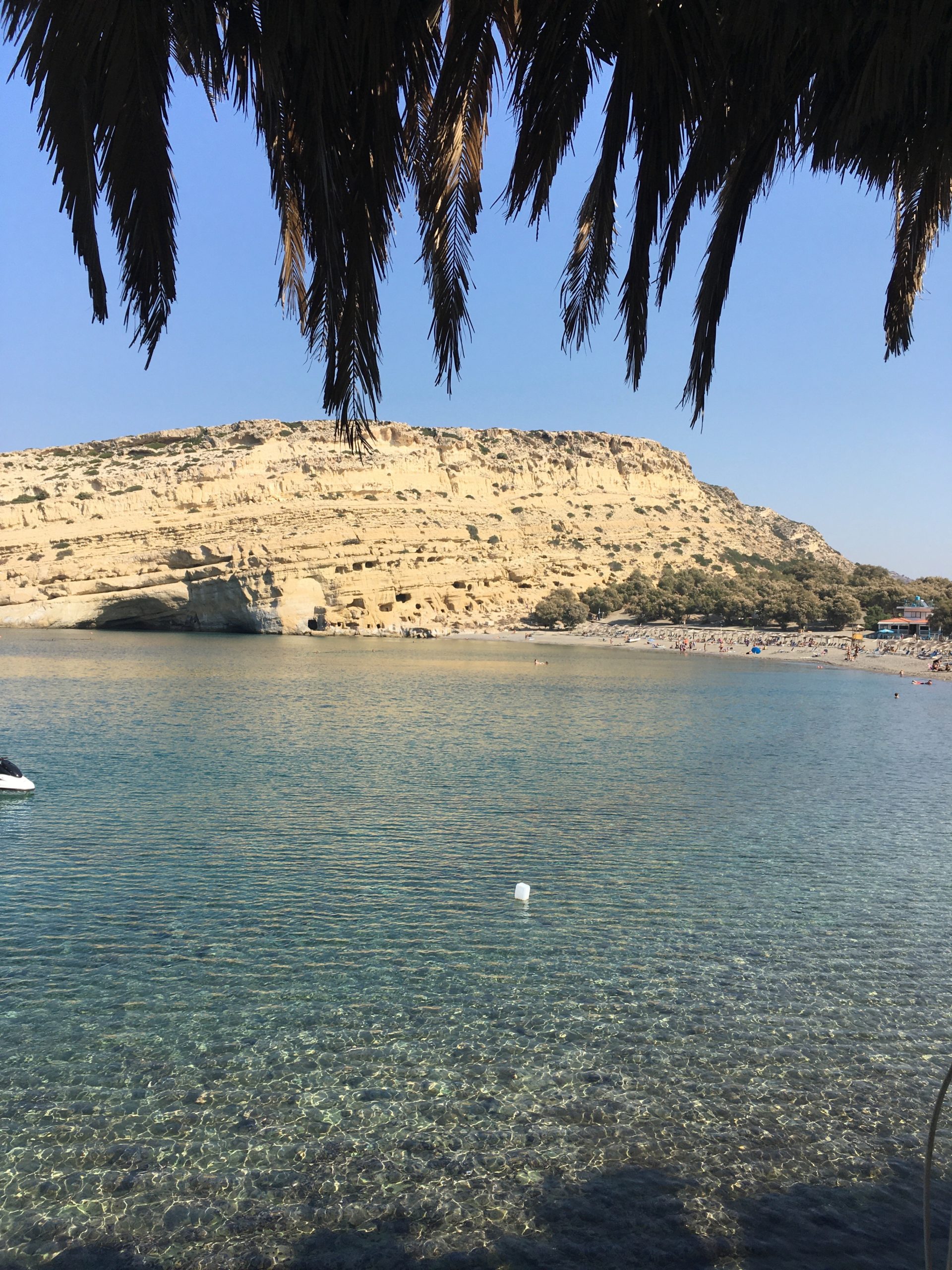
Chapter Six
It took no more than three hours to reach Matala and by the early afternoon the cog and the dhow were both beached and anchored to stout trees between the two headlands. However, despite the speediness of our departure from the Red Fort – Iqbal had been most active in encouraging his men to rouse themselves and get the two ships under way – two things worried me deeply.
Firstly, the weather had grown wilder on the ten-mile journey from the fort to Matala, the sea swell rough and choppy; even in the big cog I was travelling in – with Ricky and half a dozen of the Saracen pirates tending the rudder, ropes and sails – had been alarmingly buffeted and knocked about. Once again, in the south, somewhere towards the African coast there was a band of purple, brown and black, like a vast bruise. It was advancing on us.
The second troubling thing was that during the short voyage, I had spotted a score of horsemen in dazzling white and silver trotting along the road by the coast, heading towards the Red Fort. Part of me was glad that Nikos would soon be released from his bonds; part of me was apprehensive that his father would too quickly discover our perfidy.
There was a small chance that Lord Phokas would do nothing. After all, the nest of Saracen pirates in the Red Fort he had complained about to Robin had been extirpated. We had completed that part of our bargain. On the other hand, he had paid us, given us stores and arms, yet been deprived of the victims he demanded; he would have no bodies to nail up outside his house.
It depended on what sort of man Phokas was – would he seek to strike at us for denying him his cruel pleasures? Would he risk attacking us, with the inevitable casualties among his knights that would ensue, purely out of a petulant desire to punish us? I had a horrible feeling that I knew the answer.
Moreover, how long would it take the Cretan knights to discover what had happened at the Red Fort, to report back to the House of the Archon, and for Phokas to raise a force to come against us. By my calculation, if the Archon moved briskly, he could have troops here very soon, any time now.
I went to Robin with my problem, and it seemed that he had been thinking along the same lines. I found him in one of the caves with Elise, a strange Norman woman, tall and young-ish but with a great fluffy mane of grey-white hair. She was the unofficial leader of the half dozen women in our company. She had been briefly married to a young friend of mine called Will Scarlett, an outlaw who had been killed in the great battle at Arsuf.
She was crouching over a very large dead seagull, which had been split open from beak to fundament. And Elise was rooting around with bloody fingers inside the corpse of the bird. I frowned at Robin – was he indulging in his foul pagan practises once again? He saw my look and held up a hand to stop my questions, reinforcing it with a single long finger held to his lips.
I watched in silence as Elise tugged out a bloody scrap of purplish meat from the bird’s interior, and examined it closely.
“Hmmm,” she said, cocking her head on one side. Then, to my disgust, she palpitated the morsel, sniffed it and took a tiny bite of the meat.
She spat the gobbet out on to the sand of the cave floor.
“And?” said Robin.
Elise looked up at him. “The liver is bitter as wormwood,” she said. “But it is small and perfectly well formed, and not yet entirely putrid.”
“What does that mean?” I said, fascinated despite myself. Elise had a reputation for possessing second sight, and for dabbling in other less savoury magical practices. The word “witch” was bandied about when people spoke of her. But it was never spoken to her face. She called herself a wise-woman.
Elise ignored me. She spoke only to Robin: “The storm is coming and it will be powerful. The bitterness tells me that. It will strike tonight. But the tempest will not rage long. By dawn the skies will clear, the sea will calm.”
Robin thanked her and putting an arm around my shoulder he led me away from the weird widow hunched over her dead seabird. We stopped at the mouth of the cave and looked out on a busy beach scene: the men were loading our possessions into the two ships; with Owain and Little John supervision the labour. I could even see some of the Saracens pitching in to help. Iqbal was standing facing Aziz on the deck of the dhow, discussing something with much waving of hands. I could not tell if they were arguing. The boy servant in the blue turban sat on a coil of ropes, listening intently.
“Do you truly believe in all that divining nonsense, my lord?” I asked.
“Which nonsense would you have me believe in?” he snapped back.
I said nothing. Religion had long been a bone of contention between us. And the exertions of the fight at the Red Fort had reopened the half-healed wound in his thigh that he’d taken at Arsuf. I knew he was in some pain.
“My apologies, Alan,” he said at last. “Do I believe in her divinations? Well, her predictions are correct, more often than not.” He paused again. “I do not know if she is merely a very good judge of the weather or, at other times, an uncanny judge of people and very complex situations, but I do trust her. And, whatever her strange methods, her advice is almost always useful.”
“You saw the Cretan knights on the coast road to the Red Fort?” I said.
“Yes, they will be coming here soon, and in great numbers.”
I remained silent. I felt strangely reassured that Robin and I were of the same mind about the Archon and the possibility of an imminent attack.
“I want you to take command of the outer defences, Alan. Your task is to protect us here while we prepare the ships. A storm is coming, and a bad one, and we must ride it out on land. But the moment it is passed, I want us to be ready to go. Do you think you can protect us till the storm dies away?”
If my lord had one quality over and above the rest, it was that he made men want to please him. When he gave you a task, no matter how difficult – and the task he had just given me was nigh-on impossible – you wanted to do it so well that he would praise you for accomplishing it. It is a kind of magic, I suppose; real magic, not the superstitious hocus-pocus that Elise indulged in.
Robin gave me a dozen archers, those who still had shafts for their bows, and thirty Locksley men-at-arms – and Hanno. He also promised that Little John and the rest of the arrow-less archers and men-at-arms would swiftly come running to my aid when I requested it. But not until then. He needed as many strong arms as possible to complete the loading of the two ships, and particularly to get our beasts on board; and then to make sure the vessels were absolutely secure during the violence of the coming blow.
“I can’t afford to lose any more ships,” he said, with a wry smile.
The first thing I did was to post a reliable man-at-arms on top of the headland to the north, directly above the caves we had slept in, and one on the mountain to the south, to keep watch for the arrival of the Archon’s men.
Then I set the rest of the men to digging.
We worked hard all that long hot afternoon. I reinforced the skimpy brushwood fence that we had built on our arrival, which soon stretched north to south for fifty paces, chest high, across the donkey track beside the river, that was the only path by which a force of men could approach the beach.
Beyond the river, to the north, was the dense wood of Cretan pines and I felt able to leave that unguarded since it would take hours of noisy axe-work to cut a path through the thick trees and undergrowth. The pinewood spread halfway up the lower sandstone slopes of the steep headland, which contained the dozens of large caves in which we sheltered. On the southern side of the valley, to the right of the donkey track, the mountain descended in a sheer cliff face. There was no way round the brushwood fence to the south without scaling that bare, inhospitable mountainside.
By the time the sun was sinking I had a reasonably secure defensive position, I believed, the thick brushwood barrier across the track should stop a charging horse, or give it pause anyway, and it would force a footman to take a little time to break through and get to our defending men on the other side. The river, the wood and the high headland protected my northern flank; the bare mountain with its sheer sides warded my southern flank.
I was wiping the sweat and dust from my brow, and glancing nervously to the south-west at the looming dark bar of the storm now only a few miles away, when I head a shout from the northern headland. The man up there, a veteran archer called Gryff ap Bryn, bellowed down that a single mounted knight was advancing up the track towards us. “Only one man?” I queried.
It was indeed one man – it was, in fact, Kavallarious Nikos Phokas.
He walked his horse slowly up the centre of the donkey track towards the brushwood barrier, much as he had done the first time we met – was that only two days ago, it seemed an age?
He was helmetless, and his black curly hair was streaming behind him in the brisk onshore breeze. I could even see the bloody mark under his chin where my misericorde had pricked him. He bore a look of white-hot rage.
“I am very glad to see you freed of your bonds, Nikos, my friend,” I said from behind the barrier of the brushwood fence. “What news?”
“I have been sent as an envoy, a messenger, against my protests,” said the knight. “I have a communication to deliver to you all from my father.”
“I would first like to apologise, sir, once again,” I said, smiling up at him with embarrassment, “for the way that we used you at the Red Fort. It was unkind, yes, and perhaps, even cruel. But, believe me, Nikos, there were those among us who wished to do worse than bind you to your soft beds.”
“If you are trying to prevent your approaching doom, Englishman, you can save your lying breath. Justice is coming for you. Here, this very night.”
I stopped smiling and put my hand on my sword hilt.
“What do you wish to say, then, Cretan?” I had, at least, tried to mend things between us. But there was clearly no hint of forgiveness in his heart.
He didn’t answer immediately. Then he said: “I used to respect you, Alan of Westbury, and your lord as well. I though that you were honourable men who, like me sought only honour and glory, men who fought bravely in the name of Our Saviour Jesus Christ for all that was right and good . . .
He swallowed hard. “I even . . . I even admired you for your experience of the world, for your devout service in the Holy Land, fighting the infidel. And now . . . now I see I was a blind fool. You have made common cause with the Saracen – the enemies of our blood. You have sided with the Devil, against Christian knights. You are a traitor, sir. You have no honour. None.”
I couldn’t keep his eye. I admit I dropped my gaze in shame. Had I been serving Robin so long that I had completely lost my own sense of right and wrong? Maybe. I could feel Hanno at my right shoulder, staring up at the knight in shining white on the other side of the barrier. The wind had risen; I could feel the breath of the storm on my neck.
I looked up at him again. “You think yourself decent? You serve a man who would crucify his enemies and call it justice, who makes a mockery of Christ’s Passion. I serve Lord Locksley, and only him. That is my honour.”
“I am not here to bandy words, Englishman. Your lord is foresworn – an oath-breaker and a liar, too. He broke the solemn undertaking made with the Archon. And I have this message to relate to you from my father: Surrender to his justice, all of you, and he will be merciful. Lay down your arms and surrender now or, I swear, you will all die slowly in the greatest agony – your men-at-arms, your women, even your children.”
“I have seen your lord’s mercy. We defy you. Do your worst, sir.”
“Then there is nothing more to be said.” Nikos began to turn his horse.
“I say something now,” said Hanno. “You make too many threats, little knight-ling. One day they come back and bite your arse-hole. I swear it!”
They came some hours later, when the full moon had risen high above the northern headland. I had hoped – and I had, indeed, planned – that they would attack us head-on with their knights, charging straight up the track into the jaws of our brushwood defences. But, as King Richard had so often told me, even the most inspired plans never survive the first crash of combat.
They sent javelin men and slingers instead to attack our right flank.
The first I knew of it was a loud cry of agony as I was bending down and checking the bedding in the earth of one of the new sharpened stakes that held the brushwood wall below the sheer cliff of the southern mountain.
I whirled and saw a man-at-arms called Joseph with a five-foot javelin sticking out of the hollow between his shoulder and his neck. The blood was spurting thick and black and he was coughing and trembling with the shock.
“Shields,” I bellowed, “shields up.” And scrambled to get my own off its leather sling around my back and up over my head. The javelins were whistling down and fist-sized stones, too, from the slingers, a hail-storm of smooth round rocks that cracked against shields, thudded into unarmoured flesh and bounced up from the rocky ground. An archer went down, struck on the back of the head by a slung missile, I heard the snap of bone breaking an a man-at-arms screamed ten yards way, and another fell to his knees, crying out in pain, a javelin wobbling from the muscles of his upper thigh.
We were being slaughtered. I peeked up from under the rim of my big shield and saw that a score of men were on the mountainside fifty feet above us – lightly armoured men in simple linen shifts slinging stones at us from leather straps like David against Goliath; or hurling down their javelins like thunderbolts. We had no cover but our shields and instinctively we huddled in a mass, a score of men, with more joining every moment, our shields held over our heads, jammed together forming a carapace or roof on which the hurled stones bounced and cracked and the spears clattered.
There was nothing we could do but huddle and endure, and every few moments another man at the edge of the mass of forty or so Locksley men would cry out and stagger away, stricken by a missile from above – no, not nothing, I knew we would have to try to get up the sheer mountainside and attack them. But how? We had no ladders; we could not fly!
Then something very heavy indeed thumped to my shield. It was a man, someone I had never seen before. Dark hair, dark skin, dark open eyes; dead as one of the smooth round stones in the leather pouch around his waist. And sticking from his chest, transfixing his heart, was a yard of ash. An arrow.
The rain of stones seemed to be slackening. I peeked out from under the shield-roof and saw, to my great relief, on the other side of the valley, and a little to the north, a group of half a dozen men standing outside the largest of our caves, lit by the glow of cooking fires behind them. And Robin himself was there, standing among them. Archers. The bold bowmen of Sherwood.
My lord had retained six of his finest shots for just such an emergency as this, and I saw them all in turn nock, draw and loose in the old familiar way and hammer the enemy on the opposite side of the valley. Robin also drew and loosed and I jerked my head round and saw his shaft slice into the belly of a Cretan in the act of throwing his spear. The man dropped his javelin and folded around his wound, slipping, sliding uncontrollably down the mountainside and screaming like a thin-hipped woman in childbirth.
The barrage raining down on us was faltering, and in a couple of dozen heartbeats it ceased entirely. The dozen or so remaining Cretan troops on the mountain above were pulling back, retreating up the slope towards the summit. I wondered briefly what had happened to the lookout man I had posted up there just a few hours earlier – and knew he must surely be dead.
A last stone clattered on my shield and they were gone.
I could see eight or nine dead and wounded lying up there. One man calling out for help like a damned soul in a lake of fire; several others moaning and trying bravely to crawl up the slope to safety – all with arrows transfixing their limbs or their torsos. But Robin’s men outside the caves had ended their onslaught, were even now unstringing their bows. They knew better than any of us they must conserve their precious shafts. Robin’s shadow, lined by firelight, lifted A long right arm to me and gave a cheery wave. And that was when the storm hit us.
There was a tremendous crack, like the breaking of a tree and a flash of blinding white. The rain immediately began to lash down, pelting, pounding, numbing in its force, almost as thick and heavy as the shower of javelins it had replaced – though mercifully not as lethal.
I had lost six men to the light infantry up on the mountainside, two of those dead. And I cursed my own stupidity. Why had I only sent one man as a lookout on to the top of the mountain, where he could be stalked by a local man who knew the land like the back of his hand, and swiftly silenced?
Two or three would have been much better: they could have watched each other as well as the road. I had been a fool and his sad death was my responsibility. No time, though, for recriminations. There was the sound of trumpets, and a pounding in the earth, a thunder even louder than the storm.
The Cretan cavalry was charging down the track towards us, suddenly there, a hundred and fifty paces away, like a white wave driving forward between the mountain and the river, charging spread out through the grey curtains of falling rain. A flash of lightning revealed five and twenty knights, more, perhaps even thirty, at the full gallop, coming straight down the valley between the mountains and towards the frail fence of cut sticks and fronds.
“Stand to,” I was shouting madly. “Everyone! Man the ramparts!”
I stood with my men, shield up, a spear gripped in my fist, waiting behind the brushwood for the impact. Our barrier now seemed hopelessly feeble. The cavalry were seventy yards from us now, and with every beat of my heart they seemed to leap closer. I could see their own lances coming down, all together in a ripple of steel – fine work, a demonstration of their skill. To do that at the full gallop was a feat indeed. These men had trained hard for many years. They were knights, as honed as any I’d encountered.
“Archers, loose,” I shouted and my handful of bowmen, their cords already soaked, made saggy by the rain, nocked and loosed and sent a frail dozen shafts against the wall of charging horsemen. I saw one knight yanked from his saddle but no others. They were almost upon us. Death was in our midst. “Loose again, for God sake,” I yelled. “Loose, men, if you still can.”
The leading horseman, a tall fellow on the left made unrecognisable by the lowered steel visor on his shining steel helmet, had a long red pennant flying from his lance, which even the driving rain had not yet subdued.
His warhorse put a forefoot into one of the holes I had asked my men to dig that afternoon. Just a simple round hole, a foot in diameter, a foot deep, and covered with a few dry twigs and leaves to disguise it, but it was perfectly lethal to a charging warhorse. The animals’ hoof plunged deep into the round hole; the momentum of the horse carried it forward and neatly snapped the animal’s bone at the fetlock. The charger tumbled to the earth, hurling its rider, over its neck to land with a sickening thump on the rocky ground forty yards from the barricade.
A second horse did exactly the same and a third . . . I had dug more than eighty horse-trap holes on either side of the donkey track, leaving only a narrow path in the centre that was safe to traverse, and suddenly there were horses and men stumbling everywhere, tripping, flying and crashing to the earth. All across their line of attack, except in the very middle, there were horses breaking their legs, and riders flying, and other cursing riders and mounts becoming tangled in the carnage of the men and horses in front of them. The pure white wave of attacking Cretan knights had hit an unseen reef and had now broken and smashed itself into unrecognisable ruin.
We poured our remaining arrows into them; into the struggling mass of knights and their terrified, kicking, biting, eye-rolling mounts. The riders at the rear of the attacking formation, realising what was happening began to try to halt their momentum, hauling back their reins, the horses prancing and rearing high in surprise and fear, spraying water from their air-paddling hooves. But only a mere handful managed to avoid the tumbling carnage.
Two knights on the very centre of the track – the un-dug part that Nikos had safely rode in on – these two were still charging forward together at a gallop. Though they were now turning their helmeted heads, this way and that, bewildered, trying to see with the limited view through their visors what had happened to the now-absent comrades once galloping at their side.
Our final few arrows, loosed in tight volleys and concentrated only on these last two charging knights, stopped them dead: skewering man and beast, until they too staggered to a standstill, bristling shafts like a pair of hedge-pigs, slowing, faltering, flopping to earth, yards from the barricade.
I called out: “Now’s the time, boys, now! No ransoms, no prisoners!” and a picked dozen of us slipped through the small hinged part of the barricade, our gate, if you like, and rushed eagerly forward, weapons raised.
We came running out from behind our defences to murder the surviving fallen knights. It was battle at its most foul, most ignoble – in ordinary circumstances a knight would be seized upon, captured and imprisoned until a ransom could be arranged. But we could not afford to hold any knight we captured – who would guard him while we fought? Would we have to take him with us on the ships? – yet we could not afford to allow him to limp away, perhaps to be remounted and rearmed and then attack us once more.
So we murdered all the Cretan knights we could get our hands on that night, as the rains came down on us like a hundred waterfalls; it was nothing less than a muddy, bloody massacre. And may God have mercy on my soul.
I kept my sword sheathed, at first, and mainly used the misericorde. The first knight I came to was on his back, half-stunned from the fall, still struggling to breathe. I pinned him to the earth with a knee on his soaking wet chest, seized his right arm, lifted it and jammed the misericorde into his torso though a hole in his shiny fish-scale armour under his armpit. The dazed man barely resisted me, and once I had stabbed him three or four times in this manner, he relaxed and was still, rain puddling in his open eyes.
I heaved myself off the corpse and, half-scrambling, I launched myself at a second knight, a few yards away, who was trying clumsily to get to his feet. I seized the man, who had lost his helmet, by the throat with my left hand. He tried to wrench my hand free but instead received the punch of my misericorde though his cheekbone, just below his left eye. He jerked once and fell back into the mud an instant later. Only then did I release his throat.
Another knight had actually made it, shaking like an old man, to his feet and was trying to hobble away down the track towards his departing comrades. I drew my sword, ran a few steps and swung low – cutting away his right foot. He screamed and splashed to the ground, and I stepped in and dispatched him with a lunge of my sword up and under his bearded chin.
I looked about me, then, and saw that the grim task was almost done.
Hanno and the other ten men, clothes plastered wet, their blades gleaming with bloody droplets, were dispatching the last of the knights, gleefully cutting throats and cracking skulls. In a few moments, it was all over. A handful of Cretan had managed to run back to safety – but most of the knights who fell prey to the hole-traps had by now been slaughtered. My men had killed the wounded horses, too, as an act of mercy, and by the time we hurried back behind the safety of the barricade, we left sixteen dead Griffon knights lying scattered across the track between rushing, rain-swollen river on the left of our line and the sheer mountainside on the right.
None of the dead men, I was glad to learn from Hanno, was Nikos.
While we had been dispatching the wounded knights, the remaining men behind the barricades, aided by some of Robin’s reserves, had been busy building a storm shelter of sorts. It was little more than several large pieces of canvas stretched over a few long ropes, anchored with spears at either end, but it did get us out of the rain. Thank God – I was chilled to the bone.
I ordered hot soup to be served out in the makeshift tent and some bread and a few blocks of local sheep’s cheese in barrels of brine, which had been kindly provided by our enemy. I ordered a small cask of the local resinous wine to be opened too. I dispatched a trio of good men up on to the mountainside, and kept a good watch on the track leading out of the valley, too. And for more than an hour nothing stirred. The enemy had pulled back out of sight – in the dark of night that meant only a few hundred paces. Still, we saw no sign of them. Not a man. I guessed it was then about midnight.
I spoke to Edwin, the vintner of my contingent of archers, and learnt with dismay, but no great measure of surprise, that we had three arrows left.
I hope that Robin still possessed a few shafts but would not have been surprised if his cupboard were bare too.
“How soon ’fore we can fuck off from here?” asked Edwin, playing with one of the last arrows, spinning it between his thick powerful fingers.
I looked up at the dripping inside of the canvas roof, tossing, snapping and billowing in the strong wind coming off the sea. The rain was scything down out of the wild night, drumming on the canvas as hard as ever.
“Dawn,” I said. “Maybe. I don’t know. When the storm has passed. The Earl will decide. Go out with three good men and see if you can salvage any serviceable shafts from the corpses of the Griffon knights or the horses.”
“Done it already; we had a rummage while we was cutting throats . . .”
“Do it again, we need every single one. And keep your wits about you.”
Edwin shrugged and went off out into the storm.
I stole a cup of wine out of Hanno’s hand. Took a sip. It had been warmed and sweetened with honey. He snatched it back and drained it.
“What will happen now?” I said, reaching for a piece of bread.
“They wait a little, grow their balls; come again. On foot, this time.”
“Maybe they’ve had enough?”
The rugged little Bavarian man-at-arms didn’t bother to reply.
“How many you think they will throw at us this time?”
Hanno shrugged. “Hundreds. Many times what we have.”
I looked out into the black, rain-lashed space across the frail brushwood barrier. I could just make out Edwin and two others stooping and tugging at arrows lodged in dead flesh; then angrily tossing the broken ones away. We might salvage two or three shafts from the dead knights, no more than that. The arrows tended to shatter against the Cretan’s excellent scale armour, and against the big bones inside the human or horse’s body. Rain also made the goose feather flights bedraggled and useless. Thunder snarled. A gigantic flash lit up the whole sky, making the valley bright as day for a split instant.
“We try a little trick, yes? I teach you something useful,” said Hanno, unexpectedly. He reached out grabbed a passing archer by the shoulder; he pulled the man roughly towards him. “Gather me Big John here,” he said.
The archer looked at him in confusion. “He means Little John,” I said, “John Nailor, up in the caves. Hanno wants you to bring him here. Go on.”
He told me what he wanted to do, how he planned to stop the next Cretan attack. Once I understood what was in his mind, I shuddered – then reluctantly agreed. Unpleasant as it was, it was a decent ruse, a good plan.
Ends
Robin Hood and the Caliph’s Gold is available as a paperback, an eBook and an audio book from Amazon. If you want to start the Outlaw Chronicles series from the beginning, read the first novel Outlaw. This is a list of all the Outlaw Chronicles in the correct order.
Comments (0)