A chapter a day: Robin Hood and the Caliph’s Gold – Chapter One
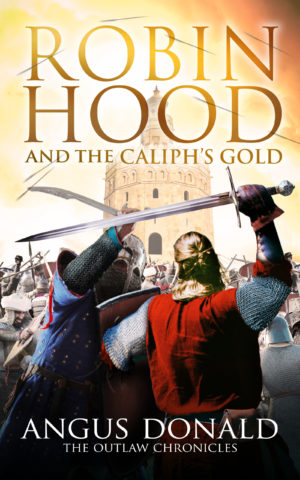
I’ve decided to post a new chapter each day of my novel Robin Hood of the Caliph’s Gold, so that people who are not familiar the bestselling Outlaw Chronicles series (11 novels have been published so far) can sample it to see if it is to their taste. In this full-length story, which is chronologically Book 3 of the Chronicles, Robin Hood and his men are on their way home from the Third Crusade, when their ship is engulfed by a terrible storm off the southern coast of Crete . . .
Chapter One
The storm came ravening out of Africa; a formless beast of wind and water and fury. It drove up from the south in a black wall and smashed into the side of the ship; one gigantic wave lifting and canting our large vessel – the Tarrada – far over on the starboard beam. The rain lashed the round ship in freezing torrents, hard as hail, filling the air completely with moisture so that it became almost impossible to breathe. I seized hold of a backstay with both hands as the deck beneath my feet surged upwards. Nevertheless, choking, spluttering in the suddenly blinding wet, I struggled to keep my feet on the slippery planks beneath me. The kindly sunlight of a Mediterranean mid-afternoon was immediately extinguished as the ship was thrust into this grey roaring waterfall. The wind howled about me, the ship plunged and slewed round a quarter turn, hurling my body in a short arc to crash into the ship’s rail. Had I not been holding to the rope, I’d have been swept to my doom.
One poor fellow, our company’s only priest, who been standing unwarily by the starboard rail, was indeed snatched up and hurled overboard, immediately lost to the ocean. I caught one glimpse of Father Simon’s white terrified face, and wide, silently screaming mouth, before he disappeared for ever, and my first thought was: This is Robin’s fault! He is entirely to blame.
After that I had no time for musing, nor for more than a passing sorrow at the priest’s fate. I was clinging for my life to the taut rope as the ship danced beneath me, soaring as a wave bore it upwards, dropping like a stone as the seas hollowed out a space below its timbers, and smashing into the water. A green wave crashed across the deck, slapping the breath from my lungs, wrenching the backstay from my grip. I dropped and slid, panicking like a child, bashing once more into the rail but, by God’s grace and my own desperate lunge, finding a hold, hugging the hard wood into my armpit.
Another wave smashed into me and its horrible power sucked at my body, but I gripped harder, squashing my body into the corner between deck and rail, until the wave’s grip slackened, released me and ship righted herself.
When able to look up again, I saw a dozen men on deck in similar poses to mine: huddled, soaked, clinging on for dear life. But surely there had been at least twice that number on the deck when the storm had struck. How many were lost? I thought, and then again: This is all Robin’s fault.
A spike of white lightning split the black sky, and vast groan of thunder followed immediately like the grinding of two mountains. The iron cascade of rain battered my head without mercy. I lifted my eyes to the aftcastle, the raised fighting platform at the rear of the Tarrada, which housed the massively thick steering oar, and saw Robin Odo, Earl of Locksley, lord of this company, owner of the vessel, and indirect author of this watery madness. He and the ship’s captain were wrapped like drenched monkeys around the steering oar, or the tiller, as I had also heard it called, struggling to keep their course as the ship was madly buffeted about by the storm.
Yet I could also see that despite the bellowing of the tempest, and the desperate prancing of the ship, Robin and the captain, a stocky piratical type called Aziz, were arguing furiously about something. I could see mouths opening and closing, exaggerated facial expressions of mutual disagreement.
Captain Aziz was occasionally gesturing quickly with one hand towards the north, when he could afford to release the long wooden tiller for an instant. It was quite obvious that Robin did not at all agree with him. But after a few moments of screaming back and forth – the meaning of their words stripped away by the wind before they reached me – I could see that Aziz had won the dispute. Robin nodded reluctantly and I saw them lunge together, their weights combined, and heave the tiller over to the right.
There was a squealing of whistles, just audible over the howl of wind, and a stamping of bare feet on the rain-slick deck as the crew ran to their stations. I watched with humble awe as the nimble sailors scrambled up the various rope spider-works that held the three masts and their yards in place, quite contemptuous of the whip and fury of the weather. They loosed this sail and tightened another, hauled tight on that rope or line – despite many years of travelling, my understanding of the intricacies of seamanship is still lamentably poor – and the ship came around, the canvas of the sails snapping angrily in the tumult, more ropes were pulled in, tied off, and we began to run north with the wind and the storm directly behind us.
The noise dropped immediately, our passage became smoother and, although we were still regularly battered with rain bursts and the ship buffeted with great swells, my deep terror that the Tarrada was about to be plunged to the bottom of the ocean slowly began to subside. We were travelling at a vast lick, being thrust remorselessly, so it seemed, by the very sea itself in this new direction of travel. I was drenched, dripping and chattering with cold, but when I finally released my death grip on the rail, got unsteadily to my feet and wiped the running water from my eyes, I found that Robin himself was standing right beside me.
“Aziz says we must make for dry land. He says we must find shelter.”
“Where?” I shouted over the still-considerable din of the elements.
“He thinks the island of Crete is only a dozen miles to the north. We can ride out the storm there. I think we should battle on but Aziz knows these waters. He says we will be ripped in twain if we do not make landfall.”
“It’s the storm season,” I bellowed. “It’s mid-October, too bloody late in the year to start a long voyage. We should all have stayed safe and dry in Jaffa. But you insisted, you said we must sail now, or we’d never get . . .”
“Don’t start with me, Alan,” my master yelled back. “This isn’t the time. Go below and check on the horses, will you. They’ll be in a rare state.”
That stopped me. My own beloved mount, a fine grey gelding called Ghost, was stabled below. I took a hard breath and, as usual, meekly obeyed my lord’s command. Robin turned away and walked forward beside the rail, balanced like an acrobat and riding the wild heaves of the ship with irritating ease. I started to work my way aft through the splash and spray, clinging to the ship’s rigging whenever I could, stumbling, slipping, creeping slowly towards the hatch that led down to the hold. The deck bucked beneath my feet with every cautious landlubberly step. God knew what our beasts must make of this mad agitation of their cramped quarters below. Horses cannot vomit, of course, but in their distress the other end of the animal can certainly make up for this natural deficit. Above me lightning cracked, the thunder roared out its terrible pain; the rain hammered the deck mercilessly.
We very nearly made it safely to land. The coast of Crete was a dark looming shape on the horizon, visible through the veils of rain, rushing towards us with alarming speed. The sailors had taken down most of the sails by now and we were scudding along under a single foresail, pulled down to half its normal height, a bed-sheet sized scrap of canvas, no more. This reckless speed, driven by the rolling waves, was still too great for my comfort yet, as we entered the mouth of a narrow bay, with a grey beach in its back teeth, I began to feel that we might possibly live to see the dawn.
I was plastered with sprayed horseshit and hay, only half washed clean by the ceaseless rain, but feeling better in my own mind. Below-deck had been a hellish shambles: one huge destrier, with a white-flecked mouth and creamy withers, had been bucking, kicking and biting everything and everyone within reach. It had been driven completely insane by the storm, kicking out the wooden panels of its stall, ripping the skin and flesh of its legs badly in the process. It had to be dispatched; and I sliced through its neck with one clean blow of my sword. The poor animal’s death seemed to calm the rest of the herd substantially. Ghost was still trembling, skittering and rolling his eyes in his stall, but I soon managed to soothe him. Softly murmuring in his wild, twitching ears, gently stroking his sweaty satin neck.
Back on deck I watched the rocky coastline approaching, measuring with my eye the distance at which I believed I could swim to safety, if absolutely necessary. Once that point was passed, I felt my own body relax, just a fraction. We were inside the bay, only a stone’s throw from the semi-circle of the beach, swooping in and I was turning to say something to the man standing next to me, when there was a tremendous screeching noise and the whole ship jumped and shuddered, coming to an abrupt, awful stop.
We were all thrown forward, the man beside me a short, heavy fellow called Edwin landing with his knee in my back, pinning me to the deck. We disentangled ourselves and stood. Aziz was screaming at his crew in a fury, and suddenly a dozen Arabs were crowded along the port rail and peering over the side at the churning ocean. The beach was only thirty yards away but the rolling waves were still pounding at us, each wave that smashed into us causing to a scream of tortured wood. We’d hit something, apparently, some outcropping of rock; a little submerged island in the centre of the bay.
“Get all the hatches open, Alan,” Robin was yelling at me from the aftcastle. “Get the horses swimming; and save as much of their gear as you can.” Then he was calling to Little John and others. I grabbed Edwin and we began fighting our way through the panicking crowds of men, ours and the Arab crew, some of whom were already throwing themselves off the stricken ship into the churning sea and paddling the short distance to land.
We hauled back the hold hatches, all of them, throwing them wide and got the ridged loading boards in place, the rain still hammering down, and with the help of a dozen of Robin’s men we started leading the frightened horses out of the hold. Some men, following Robin’s directions, were seizing sacks and boxes, and barrels of goods, and hurling them over the sides; many of them sank immediately, others bobbed sluggishly in the waves and swimming men guided the containers that floated to the beach.
The lower decks of the vessel were now awash and, at the front on the port side, I could see by dim light a thick jet of sea spurting like a severed artery, pumping saltwater deep inside the shattered body of the round ship.
I swung onto Ghost’s bare back, got him clattering up the loading ramp on to the deck and urged him with my heels to jump into the white-whipped sea. He balked only once, then as a massive bolt of lightning bleached the sky, he gathered all his courage made a truly heroic leap and splashed down heavily into the roiling water. A dozen heartbeats later we were shaking seawater from ourselves on firm sand. Behind me, I could hear the grinding of the Tarrada’s torn-open planks against the submerged rock even over the dreadful noise of the storm. But we were, praise God, now on land, if not particularly dry, and I took a moment to say a grateful prayer and thank my patron saint Michael, the great warrior archangel, for my safe deliverance.
We worked until nightfall to get all the men and horses and as much of the goods, food and war gear off the stricken ship. Then we anchored the Tarrada with three lines attached to trees and rocks on the small beach.
We piled the pitifully few barrels and boxes that had survived on the beach under a lashed-down tarpaulin and led the sick and trembling horses to the shelter of a thick wood on the northern side of the bay. We tethered the exhausted creatures under the trees, a strange type of local pine with thick gnarled trunks, long drooping limbs and delicate almost feathery green leaves that turned white-brown at the tips. The trees grew so close together, and undergrowth was so dense, that they made a natural barrier, virtually impenetrable to a man or a horse. I thought we ought to camp beneath them; if we wove the branches overhead together, I reckoned, we could make a nearly waterproof ceiling for our makeshift camp. However, Hanno, an iron-tough, shaven-headed Bavarian man-at-arms, loudly disagreed with me.
“I know a better sleep-place,” he said, in his unique brand of the English language. Hanno had joined our company of English and Welsh men-at-arms in the Holy Land, after being abandoned by his own lord, Duke Leopold of Austria, and he had not only become my friend and comrade but had also appointed himself my mentor in all of the varied arts of warfare.
Hanno had scouted the bay while we were busy unloading the ship and had discovered, apart from a few ramshackle fishermen’s shacks, apparently abandoned by their owners for the winter months, an extensive series of dry, spacious caves burrowed into the sandstone of the bay’s northern headland.
By midnight, all of the ship’s surviving men were ensconced in dry warm caverns under a sandstone roof, with fires already lit and the soup boiling, the salvaged goods and gear, plied around us, steaming gently, and our exhausted men preparing to spend the night in relative comfort. I stood at the mouth of the cave, sipping a welcome mug of barley broth, with a cheery blaze crackling behind me, and looked out through the drifting curtains of rain at the Tarrada stuck in the middle of the bay like a beached whale on its invisible perch. The fury of the storm seemed to have slackened somewhat but I wondered how we were going to get the ship off its rock and fix it up well enough to continue our journey. It seemed an impossible task.
“God’s great bulging balls,” said a rumbling voice. “I don’t know if I’ve ever been more grateful to have hard ground under my boots. I near shat my braies when we came barrelling in and ripped out our arse on that reef.”
I turned to look at a huge looming shape, a man nearly seven feet in height, standing behind me. A flash of lightning lit up his vast, cherry-red face, framed by two fat, plaited ropes of sea-bedraggled blond hair. I very much doubted he had truly been close to soiling himself in fear: for my friend John Nailor, also known as Little John, was Robin’s trusted lieutenant and right-hand man and one of the most courageous warriors I’d ever met.
“Get comfortable, John,” I said. “We’re likely to be here for a long time. Heaven knows how we’re going to fix that great big hole in the hull.”
“Aziz will know how,” said Robin appearing out of the gloom of the cave to stand beside Little John and stare out into the lashing rain. “He has some fine carpenters among his crew. He’ll know just how to patch her up. But first thing in the morning, when this blow has passed, we need to get the remaining stores out of her, salvage as much as we can. Might even be worth diving for the sunken flour sacks. This little lot . . .” he waved at a pile of still-dripping barrels and boxes stacked at the rear of the caves “ . . . won’t feed us for more than three days. By the end of the week, we’ll be hungry.”
A little later, I wrapped myself up snugly in my large forest-green cloak, which was still damp from the sea but also warm from the fire, and curled in a dark sandy corner of the cave. I was tired, all muscles aching, and very dispirited, too. I thought then about our poor priest, Father Simon, who was snatched from the deck by the storm. Had God deserted us? Was He punishing us? Why would he take up to Heaven his servant and not another man? As I prepared myself for sleep, I listened to the rattle and crash of the wind in the trees of the dense wood below us and the hiss of rain on the rocks outside the cave, and thought longingly of the warm, sun-lit land we’d sailed from a week before, the land where Jesus Christ himself had walked.
The Tarrada was a dismal sight, even from a distance. She was tied up at the end of long, rickety wooden jetty that speared out into the Mediterranean Sea from the harbour of the port of Jaffa. She was the kind of vessel usually known as a round ship, or cog, a type of craft used for transporting large numbers of men or large quantities of goods by sea over great distances.
She was big and slow, round as her name suggested rather than fast and sleek, and she projected an incongruously sad, despondent demeanour in the bright sunshine of the Holy Land. Like a large plain girl at a jolly country wedding who cannot find a young man to dance with her. She was dirty too. Her sides were streaked with filth where her sailors had carelessly relieved themselves, year after year, themselves into the big ocean. The paintwork on her two square fighting castles, one each at bow and stern, had once been glorious gold and imposing black but was now a faded yellow-orange and a sludgy brown. All her visible ironwork – cleats, bolts, chains – was rusty.
In short, she looked neglected – mainly because she had been.
“Yet he swears in the Name of Allah that all her timbers are sound?” said Robin to Aziz, who passed on his enquiry to a skinny, elderly Arab man, who was acting for the ship’s owner. This owner was rich a Jaffa merchant who, for a variety of good reasons, had not wanted to be seen to trade directly with the infidels of the Great Pilgrimage – the Christian knights who had arrived in the Holy Land in their thousands over the past year and who, under the command of lion-hearted King Richard of England, had trounced the great Muslim warlord Saladin at the bloody Battle of Arsuf only a few weeks before. I listened to Aziz’s question and its answer, having picked up a decent knowledge of the language from an Arab girl whom I’d loved and very painfully lost – a skill that neither Aziz nor the seller’s agent knew I possessed. Robin glanced at me, and I gave him the merest suggestion of a confirmatory nod, which meant: “He is speaking the truth”.
Robin did not entirely trust Aziz – he was not an original member of our company but a local seafaring man with wide connections whom Robin had had several murky dealings with in the past. There were ugly rumours about his true allegiances and I’d been brought to this meeting at the harbour to use my language skills to make a discreet test of the captain’s good faith
“He swears they are all sound,” said Aziz. “I’ve looked below decks myself – there is some rot and a little sea-worm damage but I believe the ship will carry us to Messina and then on to Marseilles. However, I consider his price too high. I shall offer him only half the sum he has demanded . . .”
I left Robin and Aziz to their haggling with the Arab, listening with only half an ear, and wandered away along the jetty towards the Tarrada to get a better look at her. She was about two hundred feet in length, the size of a moderate hall in England, and it seemed to me that she was too small, old and tired, to carry more than a hundred Welsh and English men-at-arms and archers and all their gear, as well as a handful of our women folk, three children, twelve horses, a few goats and pigs, a cock and five chickens all the way across the Mediterranean. Then there was the dry stores too, sacks of flour, salted meat and pickled vegetables in barrels, fodder for the horses, water, ale and pipes of wine, and all of Robin’s possessions, too . . .
On top of that there would be Aziz’s crew of sailors – how many would they be? A dozen? A score? That would make a total of a hundred and forty souls, more or less. I could not imagine that great mass of living, sweating human flesh fitting into the space enclosed by this little round ship – enough people to make a village, indeed more than the number of folk who lived in my own manor of Westbury, just outside the town of Nottingham, in England, which had been given to me by my lord for loyal service to him. All these travellers, human and animal, would BE crammed on this leaky casket for several weeks, the time it would take us to travel from the Holy Land to Marseilles, in the distant County of Provence. And if there was a storm . . .
This was another point of great concern for me – one that I had raised several times with Robin. The sailing season in the eastern Mediterranean ran from early March to the end of September. But we were already in the first week of October. For centuries, the local peoples had recognised that it was unwise to entrust your life to the treacherous waves during this stormy period of the year. Yet that was exactly what my lord intended to do.
Robin had dismissed my concerns. “I know you hate sea travel, Alan, but there is a risk to everything we do in this life. We might both catch an ague right here in Jaffa and die of it tomorrow . . .”
“I do know a certain amount about risking my life, lord,” I said, through clenched teeth. I had fought for Robin many times, and by his side too, and I did not like the implication I was merely terrified of putting to sea.
“Look, Alan,” he said, “We need to go home. The men are exhausted; some are wounded. I have completed the task I set myself in this land – and Richard has asked me personally to hurry back to England and act as his eyes and ears in the matter of his treacherous brother Prince John. You know what he is like. The King has requested that I do this. And a royal request is, in fact, an order. Do you want me to ignore the King’s wishes? And look at the sky, Alan – look! We’ll be fine, we’ll be absolutely fine, I promise you!”
The sky was an irreproachable blue. The glorious sun blazed down upon us. And while Robin had not mentioned it, I knew that he himself was very tired and had also been wounded in the thigh at Arsuf. I gave up trying to persuade him. For I also knew that if we did not leave now, we would not be able to sail before spring. He was right, I told myself; I’m behaving like a silly old woman who is frightened of the sea.
I slept badly on the hard sand in that damp, chilly cave on the south coast of Crete. At some point in the night I sensed that the storm had increased in its power and malignancy, the noise of the wind was louder and higher in pitch, the crashing of the waves on the rocks below a constant music, and it occurred to me that I should rise and see that all was well with Ghost, who was tied up with the other horses in the wood below the caves. But I was thoroughly worn out by the voyage and the rigours of the storm and for once I indulged my natural laziness, rolled over and sank back into a deep sleep.
In the morning – the quiet, bright morning – I stumbled to my feet and joined a handful of men at the mouth of the cave looking out at a perfectly beautiful sunny day. The sand had dried to a pale yellowish-brown, the sky and sea, a pure and innocent azure. There was no sign at all of the Tarrada.
On the strand below us, I could see Aziz, standing alone, forlornly at the edge of the water, waves lapping his boots, as he looked out at the empty bay. There were a few pieces of torn wood floating on the dark blue rippled water – but nothing more. All that had remained of the round ship was gone.
Ends
Robin Hood and the Caliph’s Gold is available as a paperback, an eBook and an audio book from Amazon. If you want to start the Outlaw Chronicles series from the beginning, read the first novel Outlaw. This is a list of all the Outlaw Chronicles in the correct order.
Comments (0)