A chapter a day: Robin Hood and the Caliph’s Gold – Chapter Five
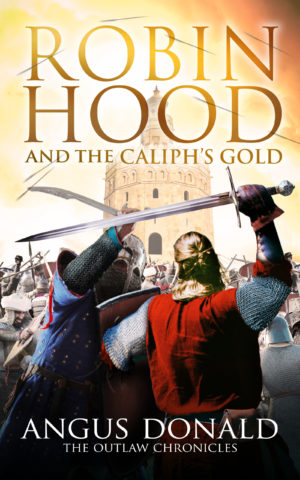
I’ve decided to post a new chapter each day of my novel Robin Hood of the Caliph’s Gold, so that people who are not familiar with the bestselling Outlaw Chronicles series (11 novels have been published so far) can sample it to see if it’s to their taste. In this fifth chapter of my novel, chronologically Book 3 of the Outlaw Chronicles, Robin Hood and his men have been shipwrecked on their way home from the Third Crusade on the southern coast of Crete and have sacked a pirate fortress to help a local potentate . . .
Chapter Five
I gave him the wine skin and he drank a good pint without pausing. Raising it in his bound hands and pouring the liquid in a red stream into his open mouth. The vintner Gareth, who was in command of the squad of clubmen, came over to me, and stood beside me, slapping the head of his bludgeon into his open palm, and staring at the little man drinking from my wine skin.
“Is this one giving you any cheek, Alan?” he asked. “Want me to teach him some manners?”
“No. Tell me, Gareth, any of these men been given meat and drink?”
“Meat and drink – a-ha-ah-aha . . .” Gareth was nearly convulsed with laughter. I stared hard at him. “Meat and drink – for heathen prisoners – and maybe some soft cushions to sit on, oh, ha-ha-ha . . . ”
I began to find him more than a little irritating.
“I’m not joking, Gareth,” I said, putting a hand on his shoulder. “Go on now, and organise some water and food, if we have it, for all these prisoners. We don’t want them dying of thirst during night. The Earl would not be pleased. Neither would the Archon. Go on, bread, water, whatever you find.”
A confused Gareth nodded obediently at me, his mouth drooping, then he stumbled away to dig up some suitable sustenance. I went over to the man clutching my wine skin, and took it back from him. It was sucked quite dry.
“Thank you . . . sir,” he said. “ ’Twas good of you. Nice vintage, too.”
“Who are you?” I said sitting down next to him.
“I’m generally called Rashid al-Bahar in these parts.”
“And in other parts?”
“Well, I used to go by the moniker Richard Seaman, or plain Ricky.”
“You’re English? How did you find yourself among these rascals.”
“Luck,” he said, and grinned at me. “All of it bad.”
Then the little Englishman started slowly, a little reluctantly, to tell me his story. He had been born in the parish of Dowgate, in the City of London. He had grown up, in his own words, a “filthy wharf rat”, and he had run away from his dirt-poor, drunken whore of a mother and gone to sea about a dozen years ago. He had started on the trading ships, bringing great tuns of wine from Aquitaine to London, but restlessly moving from ship to ship, employed as a cook’s assistant here, and then as a deck hand there, then as a helmsman and navigator. However, on one voyage on the Mary Magdalene, a fat, slow Norman cog out of Rouen, his ship had been attacked in the Bay of Biscay – attacked by swift-sailing Moorish pirates up from Salé on the African coast, rapacious and cruel men but very fine seamen, he said.
The ship had put up a fight but had been easily taken – the cog was not equipped with any fighting men – and all the crew who survived the short bloody sea-battle were enslaved. They were taken in chains to Spain and, after a long brutal land journey, to the country of Al-Andalus in the south of that sunny peninsula. They were treated very badly, Ricky said, because they were both Christians and slaves: branded, abused, whipped and beaten . . .
I held up a hand to stop Ricky’s flow of words, for I saw my lord coming over towards me. It was very late now; the night was done and dawn could not be very far off.
“I see you can talk pretty well with these prisoners, Alan,” said Robin, stifling a yawn. “I’m for my bed soon but, before I go, ask this evil-looking bastard why the two larger ships in the harbour are fully loaded with stores and provisions, even with barrels of fresh water. I’ve been looking inside all the vessels in the bay and it seems they were about to set off on a long voyage. I’d like to know where they were planning to go – and why. Can you ask this fellow that?”
I turned to Ricky, and said loudly in plain English: “You were about to set off on a journey, is that not so? What was your intended destination?”
“Alan?” said Robin. “What . . .”
“We had a right juicy target in mind,” said Ricky. “A whole plan, too.”
Robin stared at the man, digesting this. But he said nothing.
“What sort of target?” I said.
“I told you: juicy.”
I frowned at him, and he sighed: “It was to be a rich target, sir, very rich indeed; I’m talking wealth beyond the dreams of the money-lenders.”
“Very well, man, you have my attention,” said Robin. He sat down cross-legged on the ground beside Ricky and me.
“Tell me more about this juicy target.”
Ricky shook his head. “I’ll willingly tell you all I know, my lord, but only in exchange for my life and freedom – and a drop more of that wine.”
Robin laughed: “I don’t think so. Maybe I’ll just put you to the question now with fire and the knives. You would talk to me soon enough, I warrant.”
I snapped my head round and glared at Robin.
“You could certainly try that, yes,” said Ricky, nodding seriously as if he was mulling over a knotty problem with an old friend. He showed no fear at Robin’s threat of imminent torture at all. “It might work but, you know, my lord, torture is very tricky. People will tell you whatever you want to hear, when they’re in bad pain – regardless of whether it’s the truth or not. Your best bet, I’d say – and this is just my humble opinion, like – is to promise me my freedom and hear what I have to say. If you don’t like it, well, then you can always break your sacred word, besmirch your honour, and have me executed on the spot. But you will like it, sir. I know you will.”
Robin laughed again, a much kinder sound; genuine pleasure.
“I like this fellow, Alan. Let’s hear what he has to say.”
* * *
“No,” I said. “No. Absolutely not. I will not allow this – I will oppose you, my lord, with all my strength and will!”
Robin and I and Little John were sitting at a candle-lit wooden table inside the Red Fort. We had wine and bread and salty white cheese before us but nobody was breaking their fast; nobody was eating a crumb. In a corner of the small room, slumped on a bench was Hanno, snoring again. Upstairs the three Cretan knights had commandeered a room of their own, and were all snug abed. Their badly wounded comrade had died about an hour ago. At dawn, in an hour or so, we were due to set off for the House of the Archon to deliver the wretched prisoners to Lord Phokas and claim our reward.
“It’s the logical thing to do, Alan, if we are actually going to follow this new course,” said Robin. “It is the correct choice.”
“No,” I said again, banging my fist on the table. “I will not stand for it.”
“I’ll do the actual killing, if you are going to be girlish about this,” said Little John. He big red face was frowning at me in perplexity from the other side of the small table. “It would be the work of a mere moment, nothing more. Hanno would lend me a hand, if necessary. What is your problem?”
“My problem is that is would be the cold-blooded murder of our friends and allies, three innocent Cretan knights, who have done us no harm at all – indeed, who have fought with us, who have aided us and promised us further aid. It is evil, immoral. It is just plain wrong. I will not allow you to do it.”
I was feeling desperate. I truly did not want to go against my lord and Little John. Quite apart from the danger – I knew they would kill me if it became necessary – we had a bond between us I could not bear to sunder. I was thinking of Sir Richard at Lea and his casual murder at Robin’s hands.
“Alan, just listen to me,” said Robin, he fixed me with his extraordinary silver-grey eyes, and said: “If we adopt this plan of action, your new friend Ricky’s plan, that is, to take the . . . well, let’s just call it the Target, for now, the less we mention our objective the better . . . then we’ll be breaking the contract agreed between me and the Archon, the dread power in this little part of Crete. Personally, I think we should go for the Target. No question. Little John agrees. The Archon’s promise of finding us a ship was vague at best. And we have two ships, right here, right now, loaded with stores and fresh water, ready to go on a voyage. A bird in the hand . . . you agree?”
I nodded. I couldn’t deny his argument.
“When the Archon finds out we have accepted his silver and his fine weapons and armour, accepted his hospitality – and then broken our solemn word and cheated him of his prisoners, he will be angry. Yes? He will seek to punish us; he will wish to nail us up on those monstrous crosses outside his vulgar palace. But, with luck, we can be far away by then, and we can thumb our noses at the fat slug and his warped notions of justice. In order to escape, though, and get far enough away, we have to delay the news getting to him that we have, uh, changed our minds. Yes? Do you agree with me?”
I could not fault his logic.
“So if we are going to do this – if we are going to make this choice. We must kill the Cretans to give us sufficient time to escape. Yes?”
I looked into Robin’s drawn but still handsome face; and Little John’s big red shiny moon. I thought about what the slyly grinning prisoner Ricky had said about “wealth beyond the dreams of the money-lenders”.
“I have an idea,” I said.
We crept up the stairs, wincing with every creak of the wood, Hanno, Little John and me, and behind us came three of the clubmen squad. In an instant, I was beside the cot that held Kavallarious Nikos Phokas. I slapped a hard hand over his mouth and put the point of my misericorde under his jaw. His eyes snapped open, and he made to rise. I shoved the point in a little further, breaking the skin and he ceased his struggling. He glared at me, his black Cretan eyes filled with fear and hatred. I moved my hand from his mouth to his shoulder, allowing him to breathe.
“Believe me, Nikos,” I said, “I do not do this thing lightly. But it is a far, far better thing to do than the alternative.”
“Take your filthy hands off me, Englishman,” he hissed.
I shook my head, and let him feel a little more of the sharp point. Behind me, Hanno and John were busy subduing the other knights. I jerked my head to summon Will, the nearest clubman with his lengths of rope.
In a few moments, all three Cretans were tightly trussed.
“My father will crucify you for this, Alan of Westbury,” said Nikos. “And I will stand at the foot of your cross and jeer you into Hell. I swear it.”
“I am truly sorry – but we have no other choice,” I said. And I meant it.
Hanno came over to my shoulder, he looked down at the Greek lying in the bed with his hands and feet bound, and idly scratched his shaven head.
“I give you two advices, young knight-ling. Don’t make threats when helpless. And don’t threaten my friend, Alan. You get killed if you do that.”
We left the knights there, in the upper storey of the Red Fort, in their sweat-stained nightshirts, lashed to their beds. And later, much later, I wondered is that humiliation had been wise. But, at the time, I was busy congratulating myself on having saved the lives of Nikos and his two Cretan comrades.
Robin made the captured Saracen pirates, eighteen of them who survived until the pink-grey dawn, swear an oath that, if we freed them, they would not attempt to harm us, and that they would obey Robin’s commands.
Ricky – or Rashid al-Bahar as they called him – arranged this ceremony and translated my lord’s stern words about their dire punishment if they dared to cross him into the Arabic dialect they used on their pirate ships.
The former English wharf rat addressed his words mainly to a portly, middle-aged gentleman with a thin curved nose like a falcon’s beak and great bushy beard dyed bright orange-red beneath it, who was their captain, a fellow named Iqbal. As far as I could tell with my imperfect grasp of the tongue, Ricky spoke true and did not attempt to play us false – but I was very careful not to display my knowledge. Plump red-bearded Iqbal nodded along, seeming to agree wholeheartedly with the scheme Ricky proposed
As Ricky made his pitch to Iqbal and the rest of the captured Saracens, I thought about his extraordinary story, which he had completed for me in the first streaks of the new day, when I had brought him another skin of wine – his reward for revealing to Robin everything he knew about the Target.
As a Christian slave in Al-Andalus, Ricky had been sentenced to the galleys – a fearsome fate, almost a death sentence. He had been chained in a flat-bottomed craft with a hundred other wretches, fettered to their oars, and there he had laboured for two years, exposed to the elements day and night, barely fed, just slops from a bucket, often whipped, and labouring all day at the oar, sitting in his own and his fellow slaves’ filth, which was washed away only when it rained. I could barely imagine the horrors he had endured.
The galley was owned by a man named Khalil, a wealthy prince of the Almohad dynasty, the emir or lord of the Moorish province of Valencia on the eastern side of the Iberian peninsula. Even the name of the galley owner, this Prince Khalil, seemed to strike terror into the heart of little wharf rat. And Ricky was certainly no coward – he had not turned a hair when Robin had threatened him with fire and knives. But whenever Khalil’s name was mentioned, he stammered a little and seemed to grow pale despite his tan.
The Almohads were a powerful, warlike Moroccan clan from the Atlas Mountains, fanatical followers of their Prophet, Ricky said, who had risen in the past generation from obscurity to rule an empire from the deep sands of the Sahara desert, north to the plains of central Spain, from the far Atlantic coast of the Iberian Peninsula to the borders of the ancient land of Egypt.
When Ricky told me about the Almohads, and their supreme leader the Caliph Abu Yusuf Yakub, and the vast reach of their military power, I was astonished. Indeed, I was disinclined to believe him. I had heard rumours of this North African empire, whose rulers were the sworn enemies of Christendom, and close allies of our enemy Saladin, and yet confronted by an Englishman who had seen it first hand, I was assailed by doubts. Could this monstrous, sprawing heathen power really exist? Why did God allow it?
Prince Khalil – and once again Ricky’s voice shook with fear as he mentioned the name – had travelled the Mediterranean coastlines ceaselessly on behalf of his cousin the Caliph. His slaves rowing his personal galley from Valencia to Tangiers, from Algiers to Tripoli – places of which I had only vaguely heard. The galley stayed close to the land, if possible, stopping every night at a suitable beach so that the prince could sleep on solid ground.
But the Almohads’ evil grip on the waters of the western Mediterranean was not absolute. A powerful Sicilian pirate ship surprised Ricky’s galley in the waters off the town of Bougie; and the Almohad prince’s vessel was boarded and taken after a short sea chase. The crew of Valencian sailors and slave-masters was slain outright or thrown overboard to drown. But Prince Khalil was treated with respect – his name was well known, as was his connection to the Caliph – and he was held and ransomed back unharmed to his family for a fortune. The way Ricky told it, it was the wise thing to do: the Sicilian pirates would certainly have been hunted down without mercy if they had murdered the Caliph’s beloved cousin. So they treated Khalil with the utmost respect – and made a pile of silver from the Almohads. And when the deal was done, the Sicilians – most of them Arabs but with a sprinkling of Greeks and Italians – offered the galley slaves a simple choice: they could be set ashore at the next port, or they could sign up as members of the crew.
That had been seven years ago.
I felt a deep sense of satisfaction when I saw Gareth and his clubmen cutting the bonds of the eighteen surviving Saracens, and watched them rubbing their wrists and standing up in the slanting golden sunlight of early morning.
Robin had decided that we would take the two largest ships – which were both fortuitously already prepared for their own mission to attack the Target – and that we would depart as soon as we could. I understood why – the sooner we could get to Matala and pick up the rest of our people the better. The knights were still tied up like angry hogs in the Red Fort but they would get loose sooner or later, and then the hours were counting down till word reached the House of the Archon of our unexpected change of heart.
I knew from a long, pleasant conversation with Nikos the day before on the way to the Red Fort from Matala that Lord Phokas had at least a forty knights under his command, as well as several hundred well-trained men-at-arms, and a company of javelin men and slingers – and even more Cretan troops available from his fellow archons in the neighbouring districts, should he choose to call upon them. The Archon could crush us like a frog under a stone, if word of our betrayal reached him before we were safely at sea.
I had assumed in my sea-ignorance that we would then simply jump into the ships, haul on a few ropes, drop the sails, lift the anchors and be gone. But the process was far more complicated than that. Our own Arab sailors, under Captain Aziz, were still in Matala and Robin judged it too time consuming to fetch them to the Red Fort. Matala was ten miles away by sea – surely with our combined skills, we could shepherd the two ships that far.
However, it meant we were totally dependent on Ricky and the surviving Saracens – men we had been trying to kill the night before – and on their captain Iqbal, to unmoor the two ships and get them afloat.
Although they had readily agreed to the plan, it was clear that they did not love us. Then Iqbal announced that he wished to speak to Robin.
There were courtesies to be observed. Robin and Iqbal, attended by Ricky and me, sat at the table in the dark room on the ground floor of the Red Fort, and an infusion of mint, honey and boiling water was served out by one of the Saracens, a dusty boy of about eleven or twelve years in a grubby blue robe and turban, skinny and silent, who was Iqbal’s servant.
We sipped out sweet mint infusion, and Iqbal, speaking through Ricky, praised Robin for his efficiency in capturing the Red Fort so swiftly. He must be greatly blessed by Allah himself to have been so successful in war.
Robin asked him what he wanted.
Iqbal then spoke of the glories of the Mediterranean Sea, her beauty, her moods, her occasional treachery, the difficulty of navigating across her. He commiserated with Robin for the loss of his ship Tarrada, and said that he understood what a blow to our fortunes, and our joy, that must have been.
Robin thanked Iqbal, told him that time was pressing, then politely suggested that perhaps they might continue this interesting discussion at sea.
The Saracen then spoke at great length of the blessing of children – he apparently had a great many scattered all along the sea lanes – and enquired about Robin’s own family. He had taken a wife, yes? Ah, but only the one?
Robin stood up from the table. “Tell your friend,” he said, looking at Ricky, “that if he does not tell me what he wishes to discuss, I shall have him bound, gagged and thrown in the bilges of the dhow, and we will work out ourselves how to sail the ships to Matala. I cannot waste any more time.”
Iqbal, it seemed, wished to discuss the division of the spoils from the successful attack on the Target. He suggested that since Robin had no precise knowledge where the Target was to be found – only Iqbal possessed that crucial information – that Robin should receive one eighth of the booty; the other seven parts to go to Iqbal, to be divided among his remaining men.
I was impressed with this red-bearded chieftain’s coolness: he clearly understood that we were in a tearing hurry; he also knew that his men were needed to sail the ships; and only he knew exactly where the Target was. I half expected Robin to explode with rage: this fellow was pushing him hard.
Yet my lord did not. Instead, he whistled; a couple of short notes. And Little John, Hanno and a couple of burly archers came bursting into the low room. Suddenly, the space seemed very hot and crowded. John, particularly, seemed to loom like a fairytale ogre over every man in that small room
Robin said: “Get a good firm grip on him, John. And place his right hand on the table. Alan, you keep your new Dowgate friend out of this.”
There was a flurry of movement. Hanno clamped Iqbal to his seat. Little John pinned the chieftain’s hand to the table and brandished his axe, the double-blade held menacingly only a foot above the pirate’s right wrist.
I had my sword out in a flash and the point an inch from Ricky’s Adam’s apple. The London man did not move, he just looked calmly up the length of my steel blade and smiled, his dark eyes twinkling merrily at me. The boy servant cowered in the corner, his hands pressed over his mouth.
Robin said: “I hope you will forgive this crude approach but I have no time to dispute with you.” Iqbal showed no fear or surprise. He glanced down once at his hairy wrist under John’s blade, looked at Robin and smiled.
“I am going to make you a fair offer,” said my lord. “It is the best offer I’m prepared to make – you must grasp this. I know that things are done differently in your lands. But I mean this most sincerely. There is no trick, no subterfuge. This is the offer. The only offer. Do you understand me?”
Ricky made the translation and Iqbal nodded, still smiling calmly.
“I will give you half of the spoils from our mission – only half – if the Target is as rich as your man here says, there should be plenty for all of us. You will immediately, right now, without delay, help me get the two ships to Matala to pick up my friends. Then you and your man Rashid here will accompany me to the Target and aid me freely and fully to accomplish this task. You will not betray me. You will not hinder me. Nor will you quibble at all about the division of the loot. You get half, that is all – understand?”
Robin paused to let Ricky translate. Iqbal was still as cool as ice. “Furthermore, you will instruct your sailors – under my captain Aziz – to safely transport the women and children, the horses, my goods and a portion of my men to Marseilles in the cog, while we head for the Target in the other ship, the dhow. When my people have been delivered to Marseilles, and safely landed there, your men may keep the second ship – the cog. They may return it to you, or do what they please with it. This is the deal.”
Robin let this sink in. “You must agree to all of this now, at this very instant, without any attempts to bargain or change the terms, or . . . I will cut off your hand, right now, right here. And I will deliver you and all your men to the Archon for his punishment. And I will forget any notions of taking the Target, and make my own way to Marseilles and home with my people with Lord Phokas’ most generous aid. Now, answer me, sir. Do you agree?”
Ricky conversed for a while with the red-bearded captain and then gave his reply: “Iqbal says, if you will keep faith with him, he will keep faith with you. He is an honourable man, he says, and fully agrees to your proposal.”
Ends
Robin Hood and the Caliph’s Gold is available as a paperback, an eBook and an audio book from Amazon. If you want to start the Outlaw Chronicles series from the beginning, read the first novel Outlaw. This is a list of all the Outlaw Chronicles in the correct order.
Comments (0)