Ten things you (probably) didn’t know about the Mongols
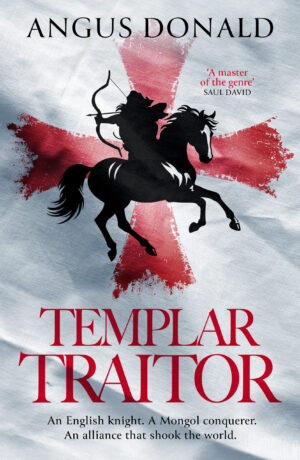
For five years I’ve been reading about and researching the 13th-century Mongol Empire for my new novel Templar Traitor (below), the first book in my Mongol Knight trilogy. The series is based on the true story of an Englishman, a renegade Templar called Robert, who fought for Genghis Khan. Here are ten things I’ve found in my research that surprised me and which will, I hope, surprise and perhaps astonish you.
- The Mongols were tolerant of all religions. The Mongols, despite their fearsome reputation, were surprisingly tolerant of all religions. Buddhists, Muslims, animists and people of various other creeds were all free to worship as they saw fit in the Mongol realms. While Genghis Khan himself worshipped the Eternal Blue Sky of the Asian steppe, there were Christians (of the Church in the East/Nestorians) among the khan’s close family. Sorkoktani, the powerful wife of Tolui, Genghis Khan’s youngest son, was a Christian. All four of her sons eventually became Great Khan and she raised them to respect all religions. Sorkoktani herself paid for the construction of a madrassa (Muslim school) in the Uzbek city of Bukhara.
- They were democratic – well, sort of. The members of each section of the army, a unit of ten men called an arban, elected their squad leader. This elected leader could rise up through the ranks and become a captain, and perhaps even a khan. Even the Great Khan of the Mongols was elected by the other lesser khans and senior generals. In medieval Europe, the King was often succeeded by his eldest son. Nobles were born into their position as a commander of warriors. In Mongol society the youngest son was considered the likeliest heir to the throne but was not automatically made Great Khan on the death of his father. After Genghis Khan died, a sort of “parliament” was called a kurutai was called and his youngest son Tolui was made Regent until it could be decided who should succeed Genghis. All the khans met at Karakorum, the capital, and voted to make Ogedei, Genghis’s second son, the new Great Khan. So Mongols chose who should lead them in battle.
- They were a whole society on the march. When the Mongol armies invaded Europe in the early part of the 13th century, chroniclers of the time said they numbered a thousand thousand, ie, a million. Indeed, their enemies very often overestimated the strength of any Mongol army. The Mongols actively cultivated this impression, since it created fear in their foes’ ranks, but the reason Mongol armies appeared to be so big was because they travelled with all their spare horses, their herds of sheep, camels and goats and their wives and children. A Mongol army was an entire society on the march, and the dust cloud they generated must have been enormous. A tumen of ten thousand Mongol warriors, in other words a small-ish army, would have travelled with three times that number of women and children; and with more than ten times that number of herd animals.
- They were masters of logistics. A medieval army was a cumbersome thing. If you try to take an army of, say, 10,000 men and a similar number of horses (both for riding and as draught animals) across enemy territory one of the biggest problems is how to feed such a multitude. You have two options: firstly to bring food and fodder with you, which requires a lot of logistics, wagons, oxen to pull the wagons, fodder for the oxen, etc. The second option is to “live off the land”, which means ravaging as you go, plundering stores from enemy villages in your path. Neither is ideal. The Mongols (though they were not averse to plunder) solved this problem by being self-sufficient. They brought along their herds of sheep, goats and horses which could feed on the steppe grass in spring and summer. Mongol warriors could be fed by drinking the milk of their sheep and mares. In extremis, they would cut a slit in their horses’ veins and drink their blood. Their horses’ were tough, sometimes scraping away layers of snow with their hooves to get to moss and grass beneath. Basically, a Mongol army was self-sufficient. This is a huge military advantage. A medieval army might well find itself starving, the Mongols could move to new pastures and keep fighting.
- They were not invincible. In the 1240s, medieval Europe had seen the Mongols conquer several individual Russian dukedoms, and destroy both the Hungarians and the Poles in pitched battle. They thought that the unstoppable Mongols would roll over western Europe with the same ease that they had conquered all the eastern lands. They were wrong. The great steppe ends in Hungary, beyond that the Mongols would have had difficulty sustaining themselves and their herds. Most scholars now think they would not have been able to conquer the strength of western Europe. In the event, the Great Khan Ogedei died in 1241, and all Mongol troops were recalled to Mongolia for a kurultai to chose the next Great Khan. They never returned to threaten western Europe again.
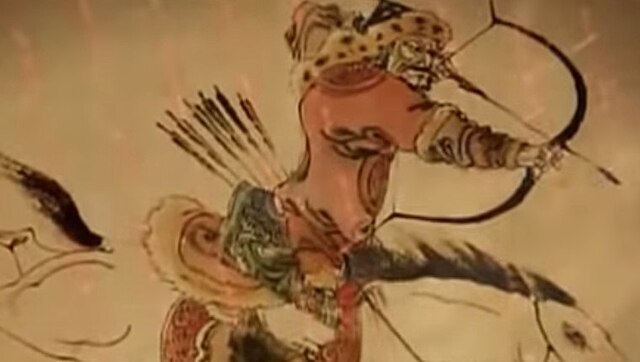
- They had excellent long-distance communications. Genghis Khan set up a corps of horse-borne messengers called Arrow Riders – so called because they were said to travel as fast as a speeding arrow. Messages sent by Arrow Rider travelled at astonishingly quickly, by medieval standards, sometimes as much as 300 miles in one day. Under the Yam system, there were staging posts on the roads every 15 to 40 miles right across the Empire where Arrow Riders could change horses and get food, drink and shelter. Fresh horses allowed them to ride continuously until the man himself was exhausted, and then another Arrow Rider could continue the journey. The world had nothing to compare to this celerity of communications until the invention of the Pony Express in the American West, six hundred years later. The Mongols also invented a revolutionary system of battlefield communications. They used coloured flags to give orders over long distances on the field of war, rather like semaphore, and shot “whistling” arrows fitted with hollow tubes, that transmitted simple general orders, such as advance or retreat.
- The Mongols had no written language. Given the vast areas under their control in the 13th century – 9 million square miles, at the empire’s peak, the largest contiguous polity the world has ever known – it is surprising that the Mongols could not write their own language. They recruited Chinese clerks (after the partial conquest of China) and used the Uighur script to phonetically transcribe messages in the Mongol tongue. These Chinese (and later Persian and Arab) clerks formed a very efficient civil service that supported the peerless Mongol war machine and allowed them to govern the enormous territory they had conquered.
- One man in every 200 is descended from Genghis Khan. DNA research done back in 2003 into Y-chromosomes found that about 16 million men worldwide were direct descendants of the Great Khan. That was 0.5% of the male population, which was then more than 6 billion (it’s now 8 billion). In Asia, apparently, between, Uzbekistan and northern China, 8% of all the men are descended from Genghis Khan. I should say here that this figure has not been conclusively proven by testing known members of the Golden Kin, as the Mongol royal family were called. Genghis Khan had four sons and perhaps five daughters, with his wife Börte, but he had hundreds of concubines, captured in war, and he may have fathered as many as a thousand children. This is less unusual than you might think: Charlemagne had at least 18 children, and geneticists (and statisticians) reckon that literally everyone with European ancestry alive today is related to the great medieval king of the Franks.
- Mongols ruled India until the 19th century. A nobleman called Babur, a warlord from Uzbekistan, who was a descendant of both Genghis Khan and Timur the Great, defeated the Sultan of Delhi in 1526 and established the Mughal Empire in India. Mughal is a form of the word Mongol. His family ruled for the next three hundred years. The last Mughal emperor, Bahadur Shah Zafar, was deposed by the British in 1857, marking the the beginning of the British Raj.
- Mongol battle tactics were taught until the 20th century. Hundreds of years after mass archery and swarms of self-sufficient light horsemen became obsolete, the basic principles of Mongol warfare – such as high mobility, combined arms, intelligence and deception, and psychological warfare – were taught in Russian military schools right up to the beginning First World War. Indeed, some aspects of Mongol strategy are still studied in military academies today.
Templar Traitor (Book 1 of the Mongol Knight trilogy) is available as a paperback, eBook and audio book from Amazon and other good book sellers. Book 2, Templar Assassin, will be out in August 2026 but can be pre-ordered now.
Comments (0)